






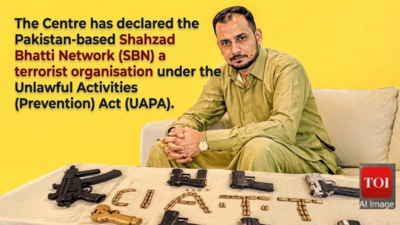
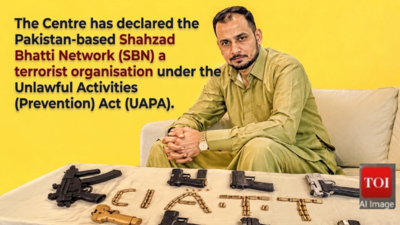
CHANDIGARH: Punjab is heading into an election year with a security problem that has outgrown its border villages. Over the past few months, the same fence has let through an AK-47, M16 rifles, Glock pistols and a rocket-propelled grenade, along with more than half of India’s seized heroin. Six policemen have been shot dead this year, some on duty, some inside their own outposts, one on his way home from the gurdwara. The most recent was found in uniform near a Gurdaspur bypass last Sunday.What links these events is less a movement than a model. Security agencies point to Shahzad Bhatti, a Pakistan-based gangster-turned-terrorist working at the behest of the ISI, and to an outfit called Tehreek-e-Taliban Hindustan (TTH) that claims attacks on social media.Handlers abroad find recruits online: a young man with a criminal streak, a woman whose husband is in jail on a drug charge, a teenager who wants quick money. They pay for small “test tasks”, ask for the video, and escalate to violence. Drones deliver the weapons. Anyone who is arrested is cheap to replace.The network is not confined to Punjab either. A railway blast in Rajasthan, a plot against police in Delhi and a car bomb in Haryana have all been traced back to it, or to the same method.However, experts are wary of calling it a revival of the Khalistan movement. Defence analyst Ajai Sahni describes the violence as largely mercenary, feeding on gangster networks and on the vulnerable. But with assembly elections due in early 2027, motive may matter less than momentum. Agencies are watching whether a steady drip of attacks can become something bigger once campaigning begins, and what that would mean for candidates, party workers and the vote itself.This story traces how that pipeline works, from the border to the phone screen to the trigger.Since February this year, Punjab has witnessed six murders of policemen. The latest victim was head constable Vinod Kumar, 42, whose blood-soaked body, still in uniform, was found near a Gurdaspur bypass last Sunday. Police said that they were investigating a social media claim by an outfit –Tehreek-e-Taliban Hindustan (TTH) — taking responsibility for the killing. TTH has made similar claims before, for at least two earlier killings of policemen.Intelligence and law enforcement agencies say that one man is behind TTH’s propaganda and operations: Shahzad Bhatti. A Pakistan-based gangster-turned-terrorist, Bhatti, as described by Indian agencies, is working at the behest of the ISI. Investigators say his method is consistent. He recruits cheap local hands online, pays them for small “test tasks”, and has them film what they do.Punjab shares a 553km border with Pakistan, and its assembly elections are due in early 2027. As campaigning nears, the weapons seizures, the drone drops and the attacks have all picked up.
How Shahzad Bhatti’s name entered the picture
Bhatti’s name surfaced in a string of cases across northern India.In January, a car packed with gas cylinders and explosives was parked inside the premises of Baldev Nagar police station in Ambala, Haryana, and blew up. In July, the National Investigation Agency chargesheeted eight accused, Bhatti among them. The agency said he had recruited and radicalised the seven arrested Indians through social media and encrypted channels. It also said some of the accused had videographed the scene for “dissemination and publicity”.In April, the Gujarat ATS detained one Bikramjit Singh alias Vicky in Deesa town. He is accused in a Punjab grenade-smuggling case and was working as a labourer at a roadside restaurant, allegedly under a concealed identity. The ATS said he disclosed links to Bhatti and his associate Abid Jutt, and that he recruited Punjab youths for the network.Then came Delhi. This summer, the Delhi Police Special Cell arrested five alleged members of a multi-state module linked to Bhatti, in a coordinated operation across Delhi, Haryana, Rajasthan and Uttar Pradesh.The accused are Sohail (26), Sonu Meena (30), Sachin Kumar Meena (20), Mohammad Kaif (21) and Mohammad Rihan (20). Police say three other members of the same module had been arrested earlier.According to police, the group had a clear brief: target police personnel, spread extremist propaganda and recruit young people. They were allegedly told to carry out reconnaissance of police stations and security camps, arrange weapons, and paste posters and graffiti promoting TTH across the Delhi-NCR region. Officials noted that TTH had recently claimed responsibility for the killing of an assistant sub-inspector in Punjab’s Amritsar district.Each accused had a role:
- Sohail painted TTH graffiti at several locations in Delhi and Faridabad and shared videos with his handlers.
- Sonu Meena arranged weapons and provided financial help.
- Kaif and Rihan were tasked with recruiting youth, scouting security establishments and planning attacks.
- Police also claimed that Rihan had been offered Rs 3 lakh to carry out a firing attack on police personnel.
- Five firearms, ten live cartridges, posters linked to the network and videos allegedly used to track and threaten police personnel were seized.
A senior officer put it plainly: TTH is a front driven by Bhatti with the strategic backing of the ISI.Defence expert Ajai Sahni says the threat is widening beyond a single handler. “There is an increasing mix of Pakistan-backed players, such as Shahzad Bhatti, Khalistani sympathisers and local gangsters. They act largely under the influence of Pakistan and, to some extent, of extremist elements in the Sikh diaspora, particularly in Canada, the US, the UK and a number of other countries.“Take Shahzad Bhatti: he has gained significant traction through his social media presence over the past two to three years, and that is why he holds some sway over gullible youths who have a penchant for landing on the wrong side of the law. Since there is clearly some degree of sympathy towards Khalistan, players like Shahzad Bhatti are ready to exploit it at the drop of a hat, as people like him enjoy clear patronage and money flowing in from Pakistan,” Sahni ponders.For Punjab, the Delhi arrests were a warning, not a comfort. TTH, the outfit the Delhi module was allegedly promoting, had just claimed the killing of an ASI in Amritsar’s Majitha, so a network built to terrorise police in Delhi-NCR is also being tied to attacks inside Punjab. It also shows the cost of this model. Recruits are paid small sums, and some are offered lakhs for a firing attack, while the handler sits in Pakistan. That makes it cheap to replace anyone who is arrested. With policemen already being shot, arms and drugs coming across the border in growing quantities, and elections approaching, each new recruit gives the network another way to strike a state that is already under strain.
The weapons pipeline
The quantity and sophistication of recovered weapons are what worry Punjab’s police most.
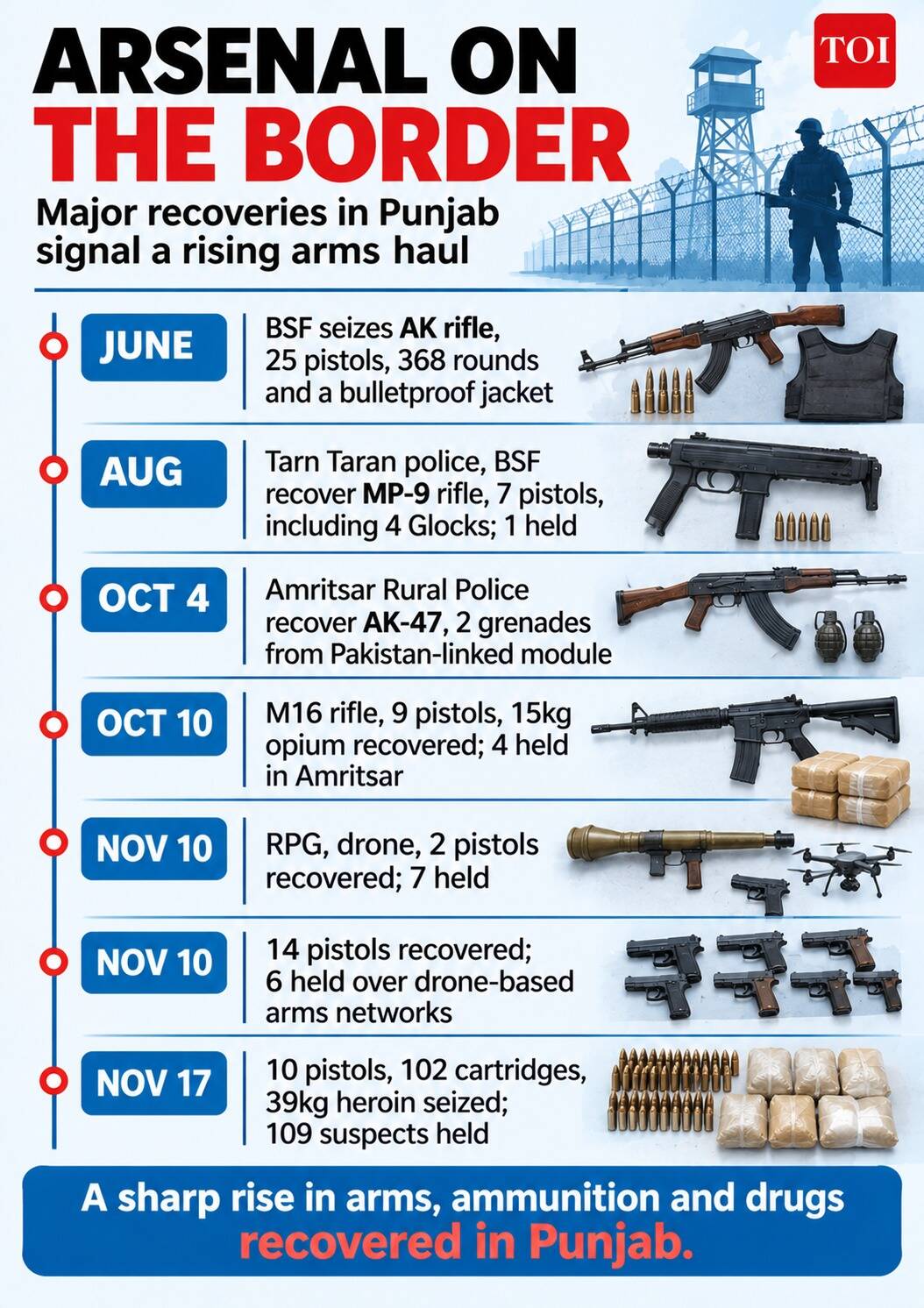
Arsenal on border
In June, the BSF seized an AK rifle, 25 pistols, 47 magazines, 368 rounds and a light bulletproof jacket. A BSF source said the jacket points to preparations for a strike, because such protective gear is rarely found in routine smuggling cases. In August, Tarn Taran Police and the BSF recovered an MP-9 rifle and seven pistols, including four Glocks.October and November brought more:October 4: Amritsar Rural Police busted a Pakistan-linked module and recovered an AK-47 and two grenades. Police said the weapons had been pushed in by drone.October 10: An M16 rifle, nine pistols and 15 kg of opium were recovered, and four people were held.November 10: Police recovered a rocket-propelled grenade, a drone and two pistols in a joint operation with a central agency. Separately, Amritsar Commissionerate Police recovered 14 pistols and arrested six people.November 17: Amritsar Rural Police seized ten pistols and 102 cartridges alongside the heroin haul.The problem goes beyond the numbers. Pistols such as Turkish-made Ziganas are reaching small-time criminals and willing teenagers, not just trained militants. Drones deliver them across the border, and police say they usually find out only after a recovery or an attack.
The drug flood
The same border and the same drone routes carry narcotics. The NCB’s latest report shows how large the problem is. Punjab accounted for 2,086kg of heroin seized in 2025, which is 58% of the national total of 3,567kg. Drone-related cases rose from three in 2021 to 305 in 2025, and Punjab accounted for 298 of the 305.A June, 2026 TOI report also flagged a “second wave” of pharmaceutical opioids, with 8,95,508 bottles of codeine-based cough syrup seized in the state, the highest in the country.Investigators have not publicly tied the heroin to Shahzad Bhatti. They do describe the same pattern, though: foreign-based handlers, drones and local couriers. On November 17, Amritsar Rural Police seized nearly 39kg of heroin along with the pistols and said the accused were in touch with such handlers. On October 14, the BSF caught a Punjab Police constable, posted with the state’s own anti-drone system, with 15 kg of heroin in his car.Narcotics money and weapons smuggling feed each other. The same networks that sell heroin can sell guns, and the profits can pay young recruits to do the shooting.
Politics, a ‘double-edged sword’
Sahni says the roots of the problem lie in politics. “Things are always controlled from the top down, and at the top is always the political leadership. Every political party in Punjab plays a double game when it comes to Khalistani sentiment and drugs.“They do not take a hard line but rather engage in soft double-speak. Although the police have arrested several people linked to drugs and gun violence, no big fish has ever been caught. To put it plainly, we must first eliminate political involvement and patronage, because organised crime is collusive. Supply matters, but only when demand carries equal weight.”
The playbook: honey traps, cash and ‘test tasks’
If the weapons are the hardware, recruitment is the software.On November 3, a blast damaged the Anupgarh-Suratgarh railway line in Sri Ganganagar, Rajasthan. Investigators say a Pakistan-based ISI handler known as “Shah” ran the operation. Rajasthan ATS arrested two people from Gurdaspur, Mahakdeep Kaur, 21, and Devendra Singh, 22.Officials say Kaur was lured through a reverse honey trap: romance, money and the promise of a better life offered online. They say she came into contact with Shah after her husband was arrested in a drug trafficking case. The two accused allegedly received Rs 2.23 lakh. Their first visit to the site on October 6 and a second attempt failed, and the blast came on the third visit. ATS chief Dinesh MN said the handler wanted to spread panic in Sri Ganganagar and across Rajasthan. Investigators analysed nearly five lakh call records and questioned over 400 people to trace the accused.
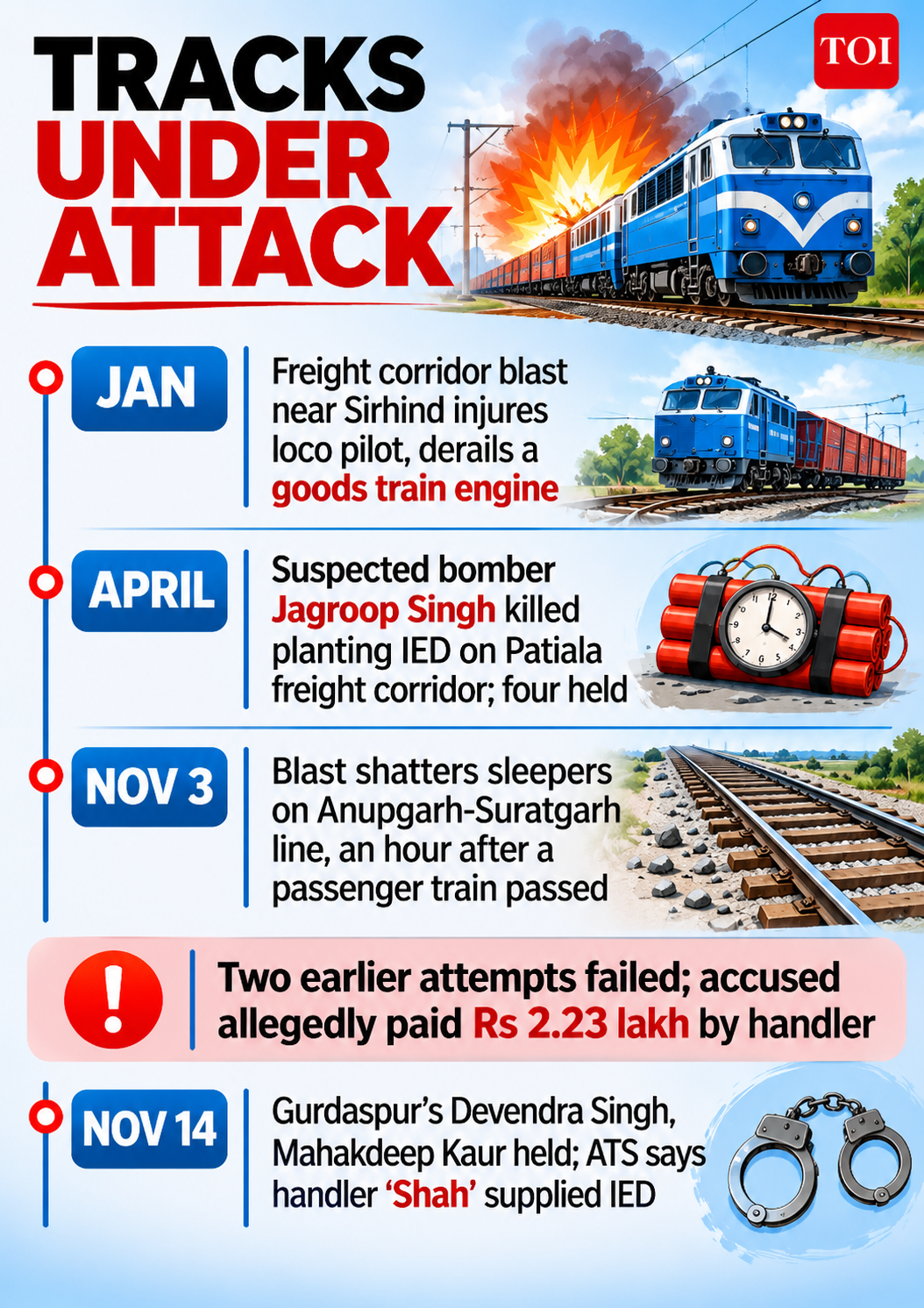
Poll-bound Punjab under fire
Officials say it fits a larger pattern. Pakistan-based operatives target lonely women online, assuming they will attract less suspicion. After Operation Sindoor, intelligence assessments showed a rise in social media recruitment by Pakistani operatives. The ATS draws parallels with Jaipur resident Babita Dhankar, arrested in June for alleged links to terror outfits across the border.Shah and Bhatti are separate names in the investigations, and no official link between them has been stated publicly. The method looks the same, however: online grooming, small payments and tasks escalating from “tests” to violence.
Why Sri Ganganagar rings alarm bells for Punjab
Sri Ganganagar in Rajasthan shares a border with both Pakistan and Punjab, and the trail from the Nov 3 blast led straight back to Gurdaspur. The two accused are from there, and Punjab Counter Intelligence helped trace them. For poll-bound Punjab, that is the warning: a handler across the border can use local recruits to hit targets in a neighbouring state, and the same network can turn back to Punjab at any time.
‘Mentoring’ young men into attackers
The Delhi cases show how an escalating task works. After Sohail’s graffiti job, the Special Cell arrested three youths who were in direct contact with Bhatti, Jatt and Gujjar. Bhatti allegedly told them to record videos showing firearms and to film themselves shooting a policeman, with hefty rewards promised.The three tracked a Uttar Pradesh Police personnel and filmed the chase. They tried to open fire, but their country-made pistol jammed. When the policeman turned around, they fled, and the Special Cell caught up with them. Officials say the case shows what the network wants: killings of police personnel, filmed and circulated as propaganda.Not every plot fails. In April, a suspected bomber was killed when an IED went off prematurely as he planted it on the freight corridor in Patiala. Four members of the module were arrested within 12 hours. Police said the module’s alleged kingpin was in contact with a Malaysia-based pro-Khalistan terrorist and Pakistan-based arms suppliers. That blast, which police called low-intensity, was the second attack on Punjab’s freight corridor this year. A January explosion near Sirhind injured a loco pilot and derailed a goods engine.
Policemen in the crosshairs
Punjab Police personnel have been the main targets this year. The list so far:February 22-23: ASI Gurnam Singh and homeguard Ashok Kumar killed inside a police outpost in Gurdaspur, close to the border.May 24: ASI Joga Singh gunned down near Majitha.September 11-12: ASI Jaswant Singh survived after a bullet grazed his head.September 18: ASI Harjit Singh killed on PCR duty in Amritsar.Early October: GRP ASI Sukhchain Singh wounded in Ajnala.October 11: ASI Iqbal Singh shot dead in Tarn Taran on his way home from the gurdwara.November 15: Head Constable Vinod Kumar found shot dead in Gurdaspur.
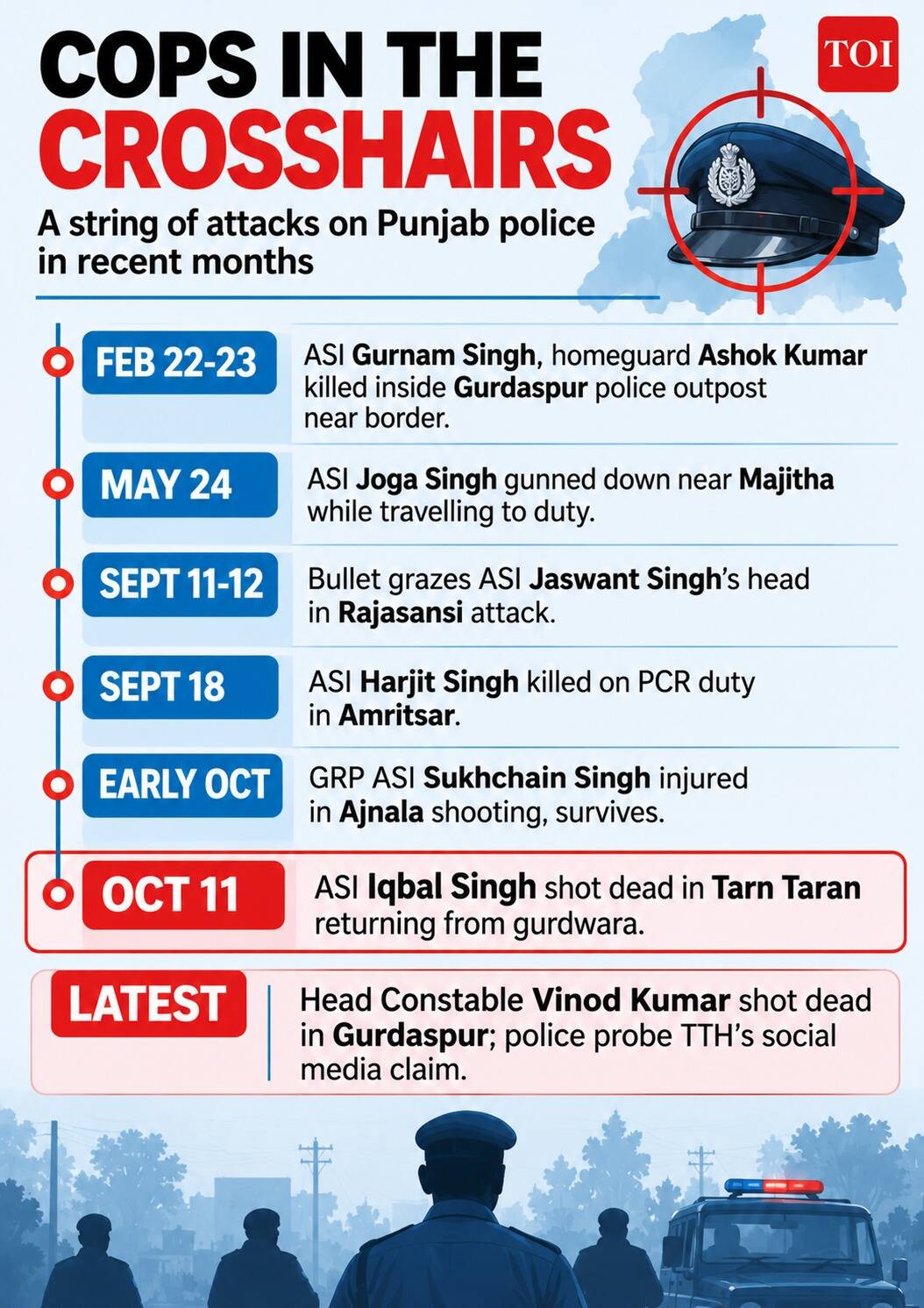
Cops in the crosshairs
Why the timing worries Punjab
Look at the last two months, and the intensity stands out. October and November together include the Tarn Taran and Amritsar arms recoveries, the 39kg heroin haul, the RPG recovery, the Sri Ganganagar railway blast and the Gurdaspur killing.Agencies are watching the same question. As campaigning intensifies, can the network turn a steady drip of attacks into something bigger? Heavy weaponry and killings of people in public life have already raised concerns about the security of candidates, party workers and the electoral process.Sahni urges caution on how to read the violence. “Election-related violence is not new in India, but because Punjab is a border state, it poses a far greater risk, not only to the state itself but also to national security. Even so, it is too early to call this a revival of the Khalistan movement, because the recent incidents are not ideologically driven. They are mainly mercenary in character, exploiting the existing networks of gangsters, as well as personal vulnerabilities, such as drug addicts or the poor..”Punjab Police point to their record: crackdowns involving joint nakas with the BSF, 109 suspects apprehended in an ongoing drive and dozens of recoveries. The state installed its own anti-drone system along the border last August. Yet when a constable posted with that very system is caught carrying heroin, the problem is plain to see.‘Manufactured grievances’Sahni cautions against reading the crisis as a problem of poverty alone. “To link this to poverty alone would be unwise. The real problem in Punjab is the progressive erosion of the quality of life. A major factor in it is the manufactured grievance that the Sikh community has not been given enough representation in politics, business and other important spheres of Indian society. These are manufactured grievances, and community members should not seek refuge in them.”With efforts underway to track other members of Bhatti’s modules, one reality is hard to ignore. The border is porous to drones and handlers can reach recruits online, so officials know the pistols, packets and propaganda videos will keep coming. The months before the vote are when that pressure will be hardest to contain.(With agency inputs)