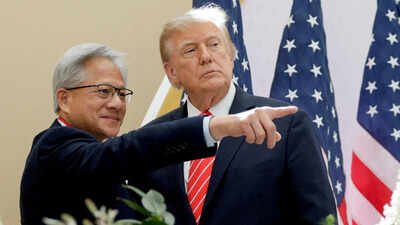




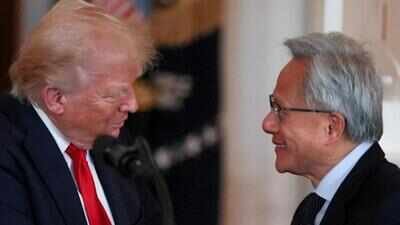
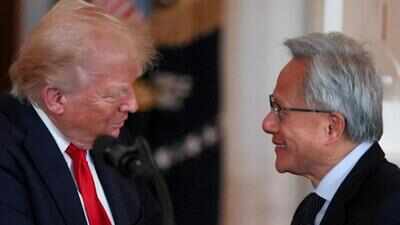
Jensen Huang’s return to Nvidia is a victory for Donald Trump‘s pressure campaign, exposing how closely corporate power, politics and national security have become intertwined in America’s battle for AI dominance.The Nvidia chief, who stepped down less than two weeks ago, is back at the helm after Trump personally pushed for his reinstatement, turning a corporate leadership crisis into a major political intervention.According to a CNN report, the Trump administration played a direct role in Huang’s comeback, with senior officials engaging with the company over concerns surrounding his departure and its implications for US national security.How Trump mounted pressure to bring Huang backTrump’s intervention went beyond publicly backing Huang. The US president personally pushed for his return, while Vice-President JD Vance also stepped in, contacting Huang and members of Nvidia’s board over the weekend. The outreach put the administration directly in the middle of a corporate leadership crisis.Trump later acknowledged his role in the reinstatement, presenting Huang’s return as an important development for American business and technological leadership.The pressure campaign reflected the administration’s concern that losing the head of the world’s most valuable AI chipmaker could have wider consequences for America’s position in the global technology race.Huang’s importance to Washington goes far beyond his role as Nvidia’s chief executive. The company has become central to America’s artificial intelligence industry, supplying advanced graphics processing units (GPUs) that power data centres, train AI models and support the development of increasingly sophisticated computing systems.With Washington seeking to maintain its technological edge over China, Nvidia’s chips have become a strategic asset. The company’s dominance in the AI hardware market also gives Huang considerable influence over the direction of the global technology industry. His continued leadership is therefore closely tied to America’s ambitions to remain ahead in the AI race.China links put Nvidia under national security scrutinyHowever, Nvidia’s growing importance to US technological leadership has also placed the company under intense scrutiny over its China business. Washington has been concerned that advanced American AI chips could be diverted to China, potentially giving Beijing access to computing capabilities that the US is trying to restrict.The concerns have also drawn attention to Singapore-based Megaspeed, which has faced scrutiny over suspected involvement in the diversion of Nvidia chips.The case highlights the challenges facing US authorities as they attempt to enforce export controls and prevent sensitive semiconductor technology from reaching China.Nvidia’s market power and the AI rallyHuang’s return has also had significant implications for financial markets. Nvidia’s position at the centre of the global AI boom means any uncertainty surrounding its leadership can ripple across the broader technology sector.Investors have closely watched the company’s leadership and business outlook as demand for AI chips continues to drive market valuations. Huang’s reinstatement has therefore been seen as a reassuring development for investors betting on the continued expansion of the AI industry.The immediate market reaction underscored that confidence, with Nvidia shares surging following the announcement of Huang’s return. The rally also lifted broader US stock indices, reflecting the chipmaker’s enormous influence on investor sentiment and the wider AI trade.However, the market optimism does not settle the questions surrounding Nvidia’s China business, export-control compliance or the administration’s role in the company’s leadership.Huang’s return may have eased investor concerns, but the national security scrutiny facing the company remains.