









The desire to have a male child, fuelled by deep-rooted patriarchal beliefs and blind faith, has turned into a reason for violence against children and women in several parts of the country. From children being murdered on the advice of occult practitioners to minor daughters being sexually abused in the hope of having a son, a series of disturbing cases has exposed how far families have gone in pursuit of a male heir.In several cases, occult practitioners allegedly exploited families’ desperation, convincing them that rituals, sexual abuse or even human sacrifice could help them have a son, cure an ailing child or bring prosperity.In one such case in Jharkhand’s Hazaribag district, police arrested a 35-year-old mother, an occult practitioner and a man in connection with the strangulation of a teenage girl during an alleged sacrificial ritual in Kusumbha village.According to Hazaribag SP Anjani Anjan and DIG Anjani Jha, the girl’s mother, Reshmi Devi, frequently visited an occult practitioner in the village, identified as 55-year-old Shanti Devi, seeking treatment for her youngest son, who suffers from physical and mental ailments. Police said the occult practitioner allegedly told the mother that a virgin girl had to be sacrificed to cure the boy of all his ailments.The police said the girl was strangled at Shanti Devi’s house on March 24, during the Ashtami night when the village was occupied with Mangla Julus celebrations for Ram Navami. The alleged killing was carried out by the girl’s mother and Bhim Ram, 40, another resident of the village.According to the police, the occult practitioner inserted a wooden stick into the girl’s private parts, while Bhim Ram struck her head to collect blood for the ritual. The three accused allegedly buried her body in a garden. Investigators said the suspects initially attempted to mislead them by claiming that the girl had been raped, a claim that was not confirmed by the postmortem or forensic report.The case also reached the Jharkhand High Court, which took suo motu notice of the alleged rape and murder and issued notices to the state administration and the police chief after reviewing media reports.A father raped daughters on an occult practitioner’s advice to have a sonIn another disturbing case from Bihar’s Buxar district, a man sexually abused his two minor daughters for years after an occult practitioner allegedly advised him to rape them to have a male child.A local POCSO court sentenced the father, Binod Kumar Singh, and occult practitioner Ajay Kumar to life imprisonment. The court also awarded 20 years’ imprisonment to the survivors’ mother and aunt, who were found to have instigated the accused.The two sisters had allegedly been sexually abused for nearly a decade before they gathered the courage to approach the police. According to the police, their father, who had only two daughters, consulted a local occult practitioner in 2012 because he wanted a son. The occult practitioner allegedly advised him to rape his own daughters.The accused later had a son, but the occult practitioner reportedly warned that the boy’s life was in danger and again advised the father to rape the girls. The occult practitioner himself subsequently began sexually abusing the sisters, reports said.After enduring the abuse for years, the sisters fled their home and approached the local police. The case was subsequently taken up for speedy trial, resulting in the conviction of all the accused.The incident prompted social scientists to raise concerns over the continuing preference for sons and the influence of patriarchal beliefs.
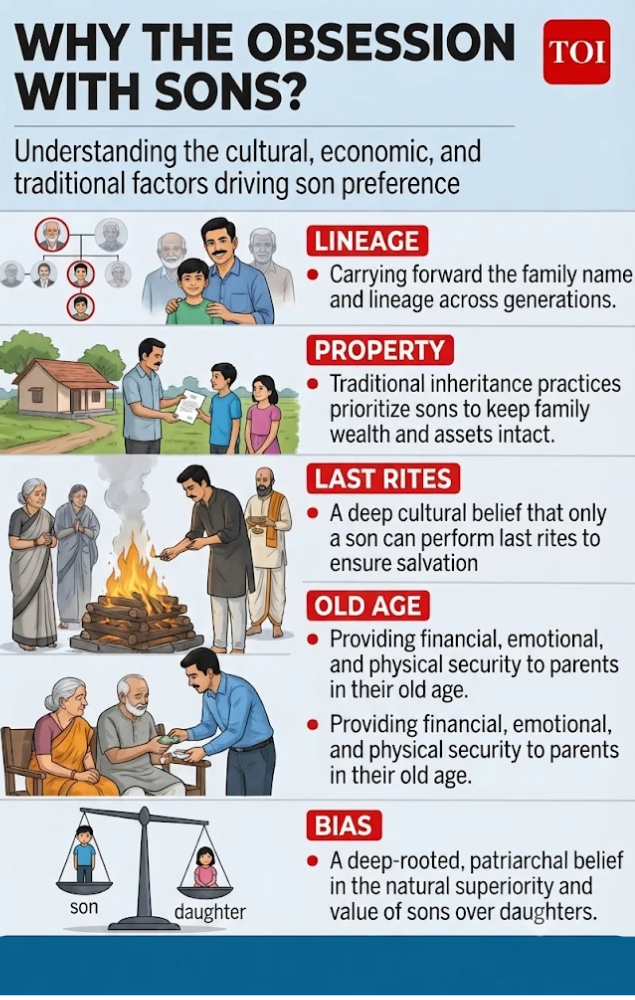
Prominent social scientist Prof Sachindra Narayan described the incident as disturbing and said such practices threatened the values of society. He attributed the problem partly to illiteracy and the continued discrimination between sons and daughters.Another social scientist, Prof BN Prasad, said such incidents would continue unless the patriarchal value system was challenged.“This (incident) is not gender discrimination; rather it is the outcome of the existing patriarchal system, and until it is challenged by the women themselves, such things will continue,” Prasad warned.He pointed out that daughters are often considered ‘paraya dhan’ (someone else’s wealth), while sons are viewed as natural inheritors of family property and are traditionally expected to perform their parents’ last rites.Human sacrifice to cure an ailing childBlind faith and the belief in human sacrifice as a means of curing illness also emerged as the motive behind the murder of a 10-year-old boy in Bahraich, Uttar Pradesh.According to additional district government counsel (Criminal) Sunil Jaiswal, the accused, Anoop Verma, 27, murdered his cousin after allegedly being convinced by an occult practitioner that sacrificing a child would cure his ailing two-year-old son.Jaiswal said Verma’s son frequently fell ill and often lost consciousness. Despite repeated medical treatment, the child’s condition did not improve. Taking advantage of the family’s distress, an occult practitioner allegedly convinced Verma that sacrificing a child from within the family would bring relief, prosperity andhe son of his paternal uncle, who trusted him completely.On the day of the incident, most family members had gone to Verma’s in-laws’ house for a mundan ceremony. Verma deliberately stayed back. When the boy returned home from school, he allegedly lured him on the pretext of buying toffees and took him to a nearby agricultural field.There, Verma attacked the child with a spad good fortune.The accused then targeted his cousin, te and slit his throat. Medical and forensic evidence presented before the court confirmed that the boy had suffered nine grievous injuries and died due to ante-mortem damage to the trachea, consistent with ritual killing.Pressure to have a male child turns into abuse of womenThe preference for a male child is not restricted to cases involving occult practices or human sacrifice. It also manifests in violence against women, forced abortions and sexual abuse within families.In Kanpur, a woman from the Babupurwa area alleged that she was forced to undergo two abortions and subjected to physical and sexual abuse by her husband’s family because they wanted a male child.The complainant, Mehak Khan, married Shah Faheed in 2021. She alleged that shortly after the marriage, her jewellery was confiscated and her husband began demanding money from her parents to start a business after leaving his job in Dubai. She was also allegedly pressured to arrange a car.According to her complaint, the harassment intensified after she gave birth to a daughter. When she became pregnant again, her in-laws allegedly conducted illegal prenatal sex determination tests, which revealed that the foetus was female.Mehak alleged that she was subsequently forced to undergo two abortions. She was also threatened that her husband would remarry if she failed to give birth to a son.The complaint further alleged that she was coerced into sexual relations with her father-in-law and brother-in-law, with her husband’s support. When she approached her mother-in-law for help, she was allegedly told to comply or face her husband’s remarriage.Mehak and her daughter were eventually thrown out of the house after she refused to comply. She approached the police and filed a case against her husband and seven members of her in-laws’ family.Inspector Arun Kumar Dwivedi of Babupurwa police station said a case had been registered based on the woman’s complaint and an investigation was underway.Son preference continues despite education and modernisationOver the years, studies and police cases have repeatedly pointed to a common thread behind such incidents: the belief that sons carry forward family lineage, inherit property, perform last rites and provide financial security to parents in old age.This preference often translates into discrimination even before a child is born. Once a pregnancy is confirmed, women can face pressure to ensure that the child is male, including demands for illegal prenatal sex determination tests despite the legal prohibition.Sex-selective abortions have continued to be a concern despite restrictions, with women in several cases allegedly being forced by husbands, in-laws and extended family members to undergo procedures if the foetus is found to be female.Research on patriarchy has also highlighted how sons are culturally associated with inheritance, lineage and religious responsibilities, while daughters are often considered temporary members of their natal families because they are expected to marry and move away.The persistence of such practices in urban and economically advanced households also indicates that education and financial progress alone have not dismantled deep-rooted gender bias.The cases across Jharkhand, Bihar and Uttar Pradesh underline how the desperation for a male heir, when combined with superstition and the exploitation of vulnerable families by occult practitioners, can have devastating consequences for children and women. From forced abortions and sexual abuse to alleged ritual killings, the victims are often those with the least power to challenge the beliefs and decisions imposed on them.