







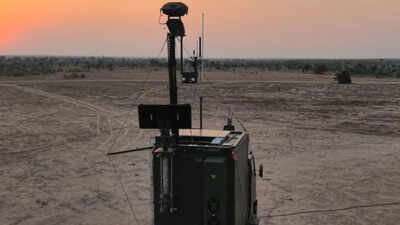
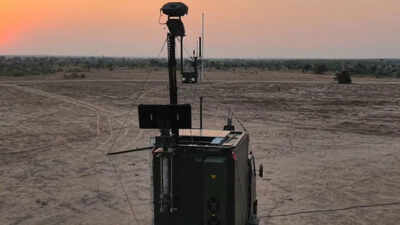
India’s indigenous counter-drone system Bhargavastra has completed its development trials at the Pokhran field firing ranges in Rajasthan. The trials demonstrated its ability to engage drone swarms using air defence rockets and guided micro-missiles.According to news agency ANI, Solar Defence and Aerospace Limited (SDAL) conducted the trials between November 20 and 24. The tests involved firing rockets and guided micro-missiles at actual swarm-drone targets to assess the system’s ability to detect, track and neutralise multiple aerial threats.The trials assessed the system’s ability to engage actual swarm-drone targets. The Rocket warheads successfully hit their designated points. Separate tests also demonstrated the guidance and terminal-homing capabilities of the micro-missiles against drone targets.The trials further evaluated the integration of sensors, surveillance radars and the command-and-control network for detecting and tracking incoming drones.ANI reported that further optimisation and trials are planned to improve the system’s engagement and kill probability. The next milestone is a prototype demonstration in its deliverable configuration.Bhargavastra systemDeveloped by Solar Defence and Aerospace Limited (SDAL), Bhargavastra is an indigenous, vehicle-mounted, two-layer counter-swarm drone system designed to detect, track and destroy multiple hostile unmanned aerial vehicles (UAVs), including coordinated drone swarms and loitering munitions.The system uses a hard-kill approach, physically destroying incoming threats rather than relying solely on electronic jamming. It combines two weapon configurations. Version-I features a 64-tube launcher firing unguided air-defence micro-rockets, while Version-II uses a 64-micro-missile launcher equipped with autonomous guidance and infrared (IR) seekers for precision engagement.The system integrates surveillance radars, passive radio-frequency (RF) detectors and electro-optical/infrared (EO/IR) sensors to identify and track incoming aerial threats.Its radar can detect small aerial targets at distances of 6 to 10 km, while the electro-optical tracking system has a reported range of around 6 km.An artificial intelligence-enabled Command, Control, Communications and Intelligence (C4I) network integrates sensor inputs, tracks targets and coordinates weapon engagement.The system is designed for deployment across different terrains, including high-altitude areas above 5,000 metres. Its modular architecture can also accommodate an additional soft-kill layer involving electronic jamming and spoofing.Bhargavastra’s significance lies in its ability to provide a layered response to the growing threat of low-cost drone attacks.Modern battlefields have increasingly seen coordinated drone swarms used to overwhelm air-defence networks, target military installations and strike critical infrastructure.The system’s unguided micro-rockets are designed to counter groups of incoming drones, while guided micro-missiles provide a precision-engagement option against individual targets. This could help reduce dependence on expensive air-defence interceptors against relatively inexpensive drones.The system has been developed under the Indian Army’s Make-II programme, with SDAL independently developing the guided micro-missile version beyond the initial rocket-based requirement.