








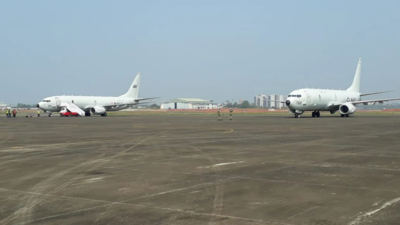
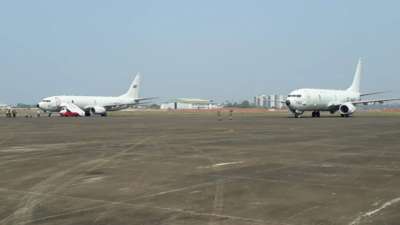
India has a clear edge over Pakistan in the air when it comes to hunting submarines, and the gap comes from range, endurance, sensors and weapons. Airborne anti-submarine warfare (ASW) is more than finding a submarine. It means locating, identifying and tracking underwater contacts, staying with them for long periods and, if needed, engaging them before they threaten ships or maritime infrastructure.India’s main platform is the Boeing P-8I Poseidon, a purpose-built long-range maritime patrol and ASW aircraft. The Navy ordered eight in 2009 and four more in 2016, making 12, and they fly from INS Rajali in Arakkonam and INS Hansa in Goa under INAS 312 and INAS 316. Built on the Boeing 737-800 airframe, with two CFM56-7 turbofans, it combines high transit speed with long endurance, so it can reach distant waters quickly and stay on station. Its sensors include maritime surveillance radar, electro-optical and infrared systems, electronic support measures, acoustic processing and sonobuoys, and it carries a magnetic anomaly detector (MAD), which picks up disturbances in the Earth’s magnetic field caused by a submarine hull and is useful in the final stage of localisation. Its weapons include Mk 54 lightweight torpedoes, depth charges and AGM-84L Harpoon Block II missiles.The P-8I works with the MH-60R Seahawk helicopters, of which India has ordered 24. With dipping sonar, sonobuoys and lightweight torpedoes, they operate from destroyers and frigates and stretch submarine detection beyond what a single ship can do, while the older Ka-28 and Sea King helicopters also contribute. The 15 MQ-9B SeaGuardian drones due from 2029 will add persistent surveillance but are not yet an ASW capability.
Pakistan’s fleet
Pakistan relies on the RAS-72 Sea Eagle, the P-3C Orion and shipborne helicopters. The RAS-72 is an ATR-72 turboprop converted for maritime patrol by Rheinland Air Service, with a Seaspray 7300E AESA radar, electro-optical sensors, electronic support measures and sonobuoy launchers. It is slower than the P-8I, and the status of its air-launched torpedo capability is not publicly established. The P-3C, with its acoustic sensors, sonobuoys and magnetic anomaly detection, has long been the backbone of the ASW fleet, but two were lost in the 2011 attack on PNS Mehran, and the survivors face maintenance, structural fatigue and spare-parts problems. Pakistan is pursuing the Sea Sultan programme, built on the Embraer Lineage 1000 with Leonardo mission systems, to replace them, though it has been delayed and its final size and schedule are unclear. For helicopters, it flies the Chinese-built Z-9EC with variable-depth sonar and torpedoes and the Sea King.
Why it matters
The difference matters because Pakistan is bringing in the Hangor-class submarines, which have air-independent propulsion (AIP) and can stay submerged for longer, making them harder to detect. The P-8I’s acoustic processing, sonobuoys and links with ships and helicopters will be central to tracking them, and its speed lets it cover the Arabian Sea, the Bay of Bengal and the wider Indian Ocean.Overall, India holds a qualitative and quantitative advantage in airborne ASW. Pakistan’s ageing aircraft still give it useful capability, but the delay to Sea Sultan leaves a gap. The real test for both navies will be how well they combine aircraft, helicopters, ships, underwater sensors and intelligence to keep contact with ever quieter submarines.