








A railway tunnel built in the 19th century using hand drills, explosives and steam-powered machinery has reopened to cyclists after seven years of closure in Wisconsin. The historic passage, where two construction crews digging from opposite ends of a hill managed to meet with an error of barely an inch, is once again accessible to visitors using the Badger State Trail.According to the Wisconsin Department of Natural Resources (DNR), which manages the trail and has documented the tunnel’s history and restoration, Stewart Tunnel reopened on November 16, 2026. Located just south of Belleville, the tunnel had been closed since 2019 after loose and falling rocks from its ceiling and side walls raised safety concerns. Its reopening follows an extensive rehabilitation project designed to stabilise the ageing structure while retaining its use as a recreational route.
How the Stewart Tunnel was built in 1886
The history of Stewart Tunnel dates back to December 13, 1886, when the Illinois Central Railroad Company began constructing a railway line between Freeport, Illinois, and Madison, Wisconsin. The tunnel was an important part of this route, which was intended to carry grain, livestock, freight and passengers.Construction began with small teams working simultaneously from the northern and southern ends of the hill. Some workers were local farmers who joined the project to earn additional money during the severe drought of 1887. They initially received $1.25 per day, while basic accommodation near the construction site cost $3.50 per week. The planned tunnel was approximately a quarter of a mile long, with a curved passage measuring 21 feet high and 14 feet wide. Building it required considerable manual effort and machinery that was relatively advanced for the period.Workers used hand drills to make holes in the limestone before placing explosives to break up the rock. At the northern entrance, a hoisting apparatus helped remove excavated material, while steam shovels were subsequently brought in to speed up the work. A 48-ton steam shovel operated at the northern end, while a smaller 20-ton machine was used at the southern end.The southern crew also used a small locomotive called Stella to transport excavated rock to a dumping area known as Lynn Hollow. Later, compressed-air drills replaced the steam-operated drills to improve the pace of excavation. The work was not without difficulties. In September 1887, workers went on strike demanding higher wages, and many left the project. Their daily pay was subsequently increased to $1.75. The crews also encountered a large underground stream and an unstable roof, forcing them to suspend drilling for several days while the structure was supported.The two teams finally met in December 1887. According to the Wisconsin DNR’s historical account, the alignment was remarkably accurate: one side was off by about an inch and the other by less than three-quarters of an inch. The tunnel was named after James Stewart, the Pennsylvania contractor who died after being thrown from a buggy while surveying the proposed railway route.
From railway passage to recreational trail
The tunnel initially served the Illinois Central Railroad, carrying passenger and freight trains through the region. Passenger services continued until the 1960s, while freight trains operated until 1976. As railway use declined, the corridor eventually became part of a recreational trail. The Wisconsin DNR began exploring its conversion in 1997, and the Badger State Trail’s master plan was approved in 2006. The trail now extends approximately 40 miles between Madison and the Wisconsin-Illinois border, passing through farmland, woodland, meadows and several small communities.Stewart Tunnel became one of its distinctive attractions because of its curved design. Unlike a straight tunnel, visitors entering the passage cannot immediately see its other end. However, falling limestone created a safety problem. In September 2019, the DNR closed the tunnel after rocks dislodged from its ceiling and landed on the trail. A temporary route along Tunnel Road allowed cyclists, hikers and other trail users to bypass the passage.
What changed during the restoration
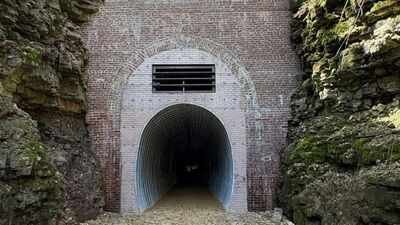
The rehabilitation involved installing a corrugated metal liner inside the approximately 1,200-foot-long tunnel. The DNR selected this approach after considering an engineering review by GEI Consultants that examined nine alternatives and receiving 901 public comments during a consultation period in 2022. According to a November 22, 2026 report by New Glarus 360, the restoration required more than 317,100 pounds of steel liner plates, over 65,000 nuts and bolts, and 4,610 cubic yards of cellular grout. Crews also installed drainage systems, footings and bulkheads, with concrete pumped around and over the new structure.The design was intended to protect visitors from falling rocks while preserving the tunnel’s importance as a winter habitat for hibernating bats. Space was retained above the metal lining to accommodate the bats. The DNR confirmed that Stewart Tunnel reopened on November 16, 2026, allowing visitors to use the passage again after seven years of detours. However, the work is not entirely finished. The department plans another temporary closure of approximately one month in spring 2027 to address an area near the southern entrance, complete minor grading and drainage work, and upgrade the permanent gates.The reopening restores access to a landmark that has served different generations of travellers, from 19th-century railway passengers to today’s cyclists and hikers.