
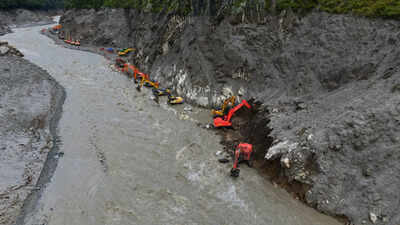
The August 26 disaster, triggered by a glacier collapse, has killed hundreds of people and left thousands missing, including hundreds of Indians, on Nepal-China border.
Catch up quick
Nepali authorities said on Monday that 903 people had died and 4,247 remained missing, including 933 workers unaccounted for at hydropower project tunnels, according to Reuters.On the Chinese side, authorities in Gyirong County reported 16 dead and 546 missing as of Monday.
Why it matters
The floods have exposed a mismatch at the heart of Nepal-China disaster cooperation: China possesses far greater resources to monitor the Tibetan Plateau, while Nepal remains acutely vulnerable to hazards generated across the mountain system.The disaster is unfolding as two very different stories on two sides of one border. Nepal’s death toll and damage estimates have climbed in near-real time with regular updates from government, journalists, and public videos from the disaster zone.China’s tally has stayed comparatively low and thin on detail, a pattern that two Nepali officials told Reuters could hamper future disaster preparedness in the region.Nepalese officials say China’s more advanced monitoring capabilities have not translated into the kind of real-time cross-border data system Kathmandu wants as climate change makes the Himalayas increasingly dangerous.The gap is forcing Kathmandu to confront how much of its safety from Himalayan glacial hazards depends on data controlled by a much larger neighbour.
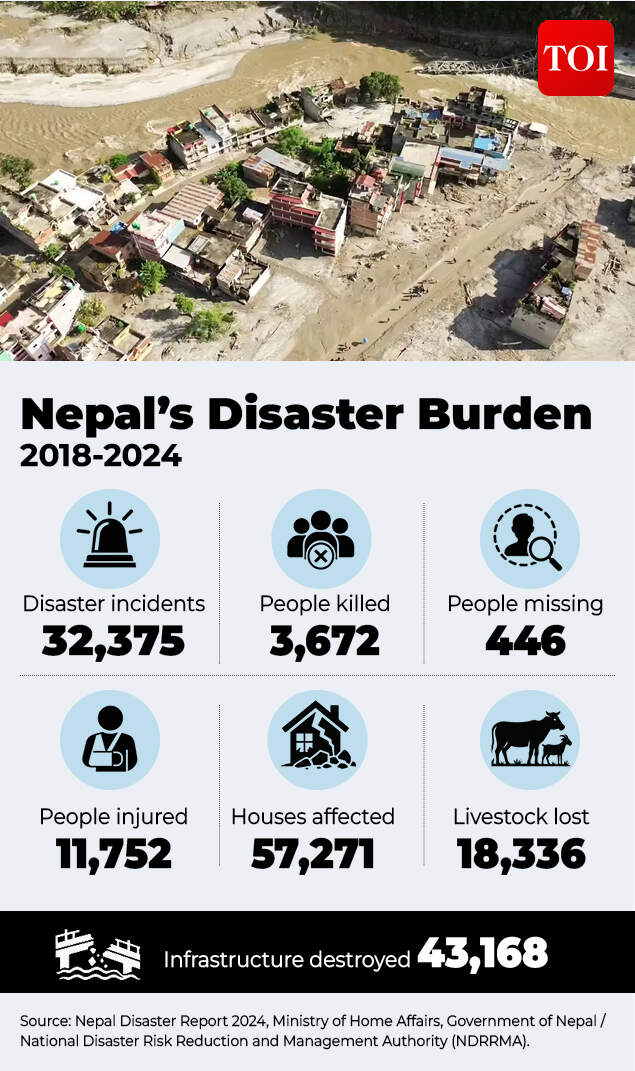
Disaster damage faced by Nepal between 2018-2024.
Zoom in
Beijing disputes the suggestion that it has failed to cooperate and there is evidence China did provide some warnings before the catastrophe.China’s foreign ministry told Reuters the two countries maintain “sound cooperation in the fields of meteorology, water resources and disaster prevention and mitigation”.“China will continue to strongly support Nepal’s disaster relief efforts, strengthen cooperation in disaster prevention and mitigation, and safeguard the common interests of the two peoples,” the ministry said.
Between the lines
The problem is the type of information being shared.China’s role is about more than missing info. Tibet’s political isolation makes independently assessing risks, casualties and the performance of authorities unusually difficult.The New York Times reported that Chinese authorities have released relatively limited information from Tibet, one of the country’s most tightly controlled regions. According to the NYT report, photographs and videos posted by bystanders and hikers were among material censored on Chinese social-media platforms after the disaster.The BBC similarly reported that footage widely seen outside China was difficult to find on the Chinese internet and that first-hand accounts from survivors in Tibet were scarce. The Guardian reported that international journalists face severe restrictions on travelling independently in Tibet, complicating outside assessment of the devastation.That information environment matters during disasters because Tibet sits upstream of several river systems that ultimately affect hundreds of millions of people across South Asia.It also creates a striking contrast: China’s emergency services possess capabilities that Nepal badly needs – from sophisticated geological monitoring to tunnel-rescue equipment – while the Chinese political system restricts independent access to the very region where much of that expertise is deployed.Chinese state media has attributed the disaster to glacier instability under the long-term effects of global warming, describing such events as an emerging danger on the Tibetan Plateau. Scientists broadly agree that warming is destabilising high-mountain environments, though they caution against attributing one specific glacier collapse to climate change before detailed analysis is complete.
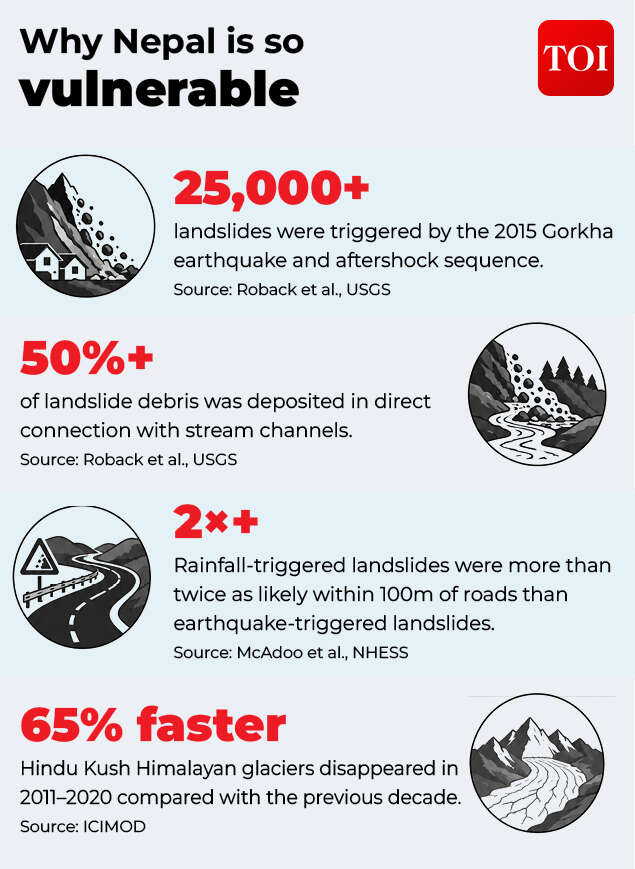
How Nepal’s geology makes it vulnerable to natural disasters.
What they’re saying
Dharam Raj Uprety, chief executive of Nepal’s National Disaster Risk Reduction and Management Authority, told Bloomberg: “People even didn’t get five minutes of lead time.” He added that Nepal lacks weather stations in high mountain areas because of the “lack of trans-boundary data seeding mechanisms,” calling it one of the country’s “biggest challenges.”Sauhardra Joshi, a Nepali hydrologist, said Nepal wanted advance notice of glacier activity from China: “if there are early movements of glaciers and early movements around that area, we would want to know a bit early,” according to a Reuters report.The Chinese embassy in Nepal said in a statement on X that Beijing has “always made every effort, within the limits of existing technologies, to conduct monitoring, assessment and analysis and have shared important information with the Nepali side in a timely manner”.Steve Tsang, director of the China Institute at SOAS University of London, told the Guardian: “Everything about Tibet is seen through the national security prism. And therefore nobody is going to say anything or report anything that has not been cleared from the very top.” He said officials on the ground “can’t report a higher figure of deaths, even if you have seen more bodies yourself, until the official statement says that the figure has gone up.” Of Beijing’s muted messaging around its own extensive rescue operation, Tsang said: “The Chinese have missed a trick,” adding that “they don’t have that confidence. Their instinct is control.”
What’s next
Kathmandu plans to seek a formal data-sharing arrangement with Beijing resembling its existing system with India, including much more frequent information on precipitation and river levels.Nepal cannot monitor the Himalayan cryosphere alone. China cannot insulate Tibet’s environmental risks behind a political frontier. And India and other downstream states face the same expanding climate threat.The harder test will be whether China shares more information before the next wall of ice, rock and water comes down the mountain.(With inputs from the agencies)