








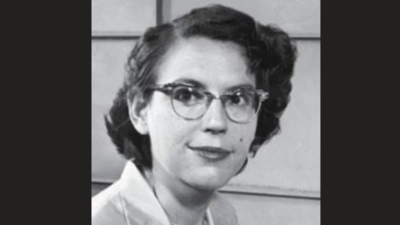
Born on a small farm near Ray, North Dakota, Mary Sherman Morgan went on to become the only woman among roughly 900 rocket scientists at North American Aviation, where she led the development of a powerful rocket fuel called Hydyne. A chemistry student whose university education was interrupted by the Second World War, Morgan put her expertise to work designing explosives before moving into the aerospace industry. Her fuel was later used in the first stage of the Jupiter-C rocket that launched Explorer 1 into orbit on 31 January 1958, marking America’s first successful satellite launch.
Mary Sherman Morgan’s work at North American Aviation
Morgan spent the war years designing explosives for the military at Plum Brook Ordnance Works. The facility played a significant role in wartime production, with Prairie Public NewsRoom reporting that the plant produced one billion pounds of munitions during the Second World War.After the war, Morgan moved into the aerospace industry, securing a position with North American Aviation, a company based in California. Her experience in chemistry and explosives proved useful in her new role, where she worked on calculating the performance of rocket fuels.According to Prairie Public NewsRoom, she was promoted to the position of Theoretical Performance Specialist. She was the only woman among nearly 900 engineers working in the field and was also one of the few employees who did not hold a college degree.
Hydyne: The powerful rocket fuel developed by Mary Sherman Morgan
North American Aviation had secured a contract to develop powerful rocket fuels capable of propelling rockets into Earth’s orbit as the United States worked towards launching satellites. Morgan’s expertise and experience led to her being appointed technical lead of the project.According to Physics Today, Morgan was the only woman among roughly 900 rocket scientists at the company and had been named technical lead of the rocket-fuel project. Her work resulted in Hydyne, a more powerful propellant developed for the American space programme.Hydyne was a mixture comprising 60 per cent unsymmetrical dimethylhydrazine and 40 per cent diethylenetriamine. The fuel was developed to improve rocket performance and was subsequently used in the first stage of the Jupiter-C rocket.
Mary Sherman Morgan’s fuel powered the launch of Explorer 1
Morgan’s work on Hydyne became particularly significant during the United States’ efforts to place its first successful satellite into orbit. According to Prairie Public NewsRoom, the new fuel powered three Jupiter-C rockets and helped launch America’s first satellite on 31 January 1958.The satellite, Explorer 1, was successfully launched into orbit, marking the beginning of the United States’ participation in the Space Age. Hydyne was used for the first stage of America’s first successful satellite launch in 1958.
Mary Sherman Morgan’s contribution to America’s space programme
Despite her involvement in developing the fuel, Morgan remained reserved about her professional achievements and rarely discussed her work. Physics Today noted that she received little credit for her accomplishments throughout her life.Morgan’s contribution was acknowledged by former colleagues after her death. At her funeral, a former co-worker told her son that she had single-handedly saved America’s space programme. Former colleagues shared similar sentiments with her family at the funeral.Morgan was married to George Richard Morgan, an engineering graduate of the California Institute of Technology, and the couple had four children. Her son, George Morgan, later wrote a play and a book about her life and work, helping bring attention to her role in the development of American rocket technology.Mary Sherman Morgan died on 4 August 2004, aged 82. Her work on Hydyne remains part of the history of the development of the rocket technology used to launch Explorer 1, America’s first successful satellite.