









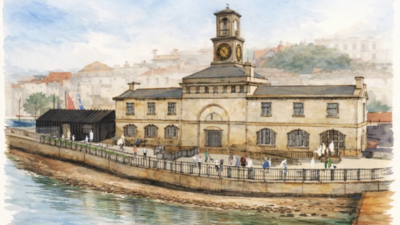
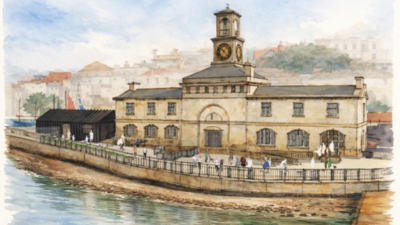
Imagine arriving at a railway station in Ramsgate, checking the time on your watch and then discovering that the town’s clocks are running almost 6 minutes ahead of the rest of the country. It might sound like a recipe for disaster, missed trains and confused travellers, but there was a time when this was perfectly normal. The coastal town in Kent once followed its own local time, known as Ramsgate Mean Time, calculated using a meridian that ran five minutes and 41 seconds ahead of Greenwich.Now, the historic building that housed this unusual piece of local history has a new lease on life. Ramsgate’s Clock House, a Grade II* listed landmark on the town’s Royal Harbour, has undergone a £7.5 million restoration after years of disrepair and being placed on Historic England’s Heritage at Risk Register. The main construction work has now been completed, bringing the much-loved harbour building a step closer to welcoming visitors again.
A clock house with its own sense of time
Built in 1817 and designed by architects Benjamin Wyatt and George Louch, the Clock House is one of the most recognisable historic buildings along Ramsgate’s Royal Harbour. Its maritime connection goes beyond its location. The building once housed the Ramsgate Meridian, a brass line used to calculate the town’s own local mean time.As explained by Visit Ramsgate, Ramsgate Mean Time was five minutes and 41 seconds ahead of Greenwich Mean Time. Before standardised time became widely adopted, towns and cities could follow their own local time, generally calculated according to the position of the sun. This meant that noon in one place did not necessarily correspond to noon somewhere else.Ramsgate’s arrangement eventually became rather inconvenient. With regular trains arriving in the town, having a different local time could cause confusion for passengers trying to catch their connections or make their way to the harbour. The town eventually reverted to Greenwich Mean Time, but its unusual meridian remains an important part of its history.The restored Clock House will preserve that connection through a brass replica of the historic Ramsgate Meridian Line, allowing visitors to see a reminder of the time when the town quite literally ran on its own clock.
From a heritage building at risk to a new harbour landmark
For a building that has stood beside the harbour for more than two centuries, the Clock House had fallen into a rather unfortunate state. Years of deterioration left the historic structure in need of extensive repairs, eventually earning it a place on Historic England’s Heritage at Risk Register.The restoration, delivered by Thanet District Council in partnership with construction company Willmott Dixon, has focused on preserving the building’s historic character while making it suitable for modern public use. According to the council’s announcement, the project involved an extensive overhaul of the structure, with particular care taken to protect its solid stone construction. Thanet District Council’s £7.5 million investment is part of a wider regeneration effort aimed at bringing new life to Ramsgate’s Royal Harbour. The council says the work has transformed the building into a heritage hub and community space for residents and visitors.In the announcement, Councillor Rick Everitt, Leader of Thanet District Council, described the project as a way of saving a piece of the town’s maritime history and creating a new cultural centre for the harbour. Richard Poulter, Managing Director at Willmott Dixon Construction South, also highlighted the challenges involved in restoring a Grade II* listed building with significant structural and environmental issues.
What will visitors find inside?
The restored Clock House is being adapted to offer more than a glimpse into its past. Plans include a flexible exhibition space celebrating Ramsgate’s maritime history, alongside a new café extension with seating overlooking the harbour. The existing containers beside the building have also been removed as part of the wider project.The council’s Clock House project page explains that the restoration and extension are intended to create a destination for both locals and visitors, rather than simply repair an old building. The museum experience is also being reimagined, with specialists working on how the town’s history and collections can be presented through exhibitions.There is still some work to be done before the full experience is ready. While the main structural and building works have been completed, the internal exhibition fittings and community programming are continuing. The new café is expected to open in the coming months, with the restored spaces being prepared for public use.
A new chapter for Ramsgate’s Royal Harbour
To celebrate the completion of the main construction works, Thanet District Council has announced a public drop-in event at the Clock House and Pier Yard on Wednesday, 25 November 2026. The event will include a ribbon-cutting ceremony and the inaugural chime of the restored clock mechanism, bringing its sound back across the harbour.For Ramsgate, the restoration is about more than giving an old clock house a fresh coat of life. It is an opportunity to reconnect with the town’s maritime past, preserve an unusual piece of local history and give residents a space they can enjoy for years to come. And somewhere inside the restored building, the brass meridian will still tell its rather charming story of a town that once kept time a little differently.