








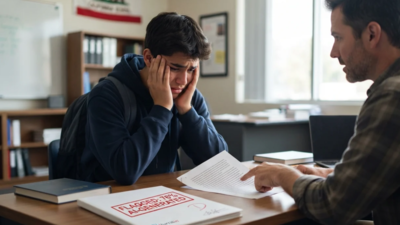
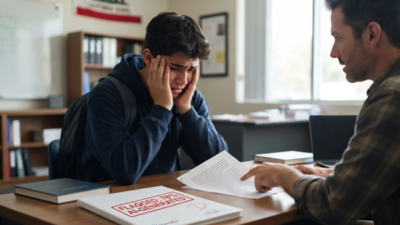
A high school student’s English essay became the centre of a dispute between his family and a California school district after software flagged much of his work as potentially written with artificial intelligence. The student had submitted an assignment on Arthur Miller’s The Crucible, but his teacher questioned its originality after an AI detection report indicated that 76% of the text had been generated or influenced by AI. He was asked to complete the work again under classroom conditions. The rewritten assignment received a D, lowering his final grade in the class to a C. His father, Takashi Kato, has now taken the school district to federal court, arguing that the accusation and the grading process were unfair.
California student accused of using AI in English essay
The dispute centres on a sophomore at Palo Alto High School in California. He submitted an essay on The Crucible, the play by American dramatist Arthur Miller that examines the Salem witch trials, on October 30, 2025. Around two weeks later, the student uploaded the work to Turnitin, a platform used by the school district to examine student submissions for possible AI involvement.According to the complaint, English teacher Sarah Bartlett informed the student that Turnitin had flagged 76% of his essay as AI-generated or AI-influenced. She also raised questions about his use of Grammarly, alleging that he had acknowledged using the tool to look up synonyms. His father disputed this account.Bartlett’s approach allowed students whose assignments were flagged to complete the work again in person. The practice was described as non-punitive, but Kato argues that it effectively placed the burden on his son to prove that he had written the original essay himself.
School’s AI detection process challenged over student’s lower grade
The student completed the assignment again under classroom conditions. The new submission received a D, according to the lawsuit, bringing his final grade in the subject down to a C.Kato argues that the school did not have a formal academic procedure governing such cases and that the decision to make his son repeat the work was not supported by a proper evaluation of the original submission. He has questioned why a software-generated percentage was allowed to carry so much weight in determining whether the student had used AI.The father also maintains that the school did not give his son a meaningful opportunity to challenge the accusation before requiring him to redo the assignment. The lawsuit describes the grading decision as arbitrary and says the procedure had consequences beyond the individual essay.
Father submits nearly 1,200 pages to challenge the allegation
Kato attempted to contest the teacher’s assessment by providing school officials with a substantial collection of material. The submission reportedly included nearly 1,200 pages of supporting evidence, among them working drafts, handwritten notes and access to the document’s revision history.The material was intended to show how the essay developed and provide a record of the student’s writing process. The family continued discussions with school officials but remained dissatisfied with the district’s handling of the matter.At one stage, Kato’s family gave the school a deadline of March 6 to award the student a neutral B grade. The district did not accept the demand, according to the report by Palo Alto Online.The disagreement eventually moved beyond the question of one English assignment. Kato is seeking to have the student’s grade restored to a B and the AI-related allegation removed from his academic record. He has also requested an independent assessment of the rewritten essay and wants the district to stop using the in-person retake practice.
Lawsuit questions AI detector accuracy and alleged school bias
The complaint raises several legal issues, including alleged discrimination, retaliation, lack of due process and improper grading procedures. Kato believes his son was treated unfairly because he is a multilingual Asian male. He also alleges that other students experienced similar accusations, including another Asian student.The father has further claimed that his son faced retaliatory treatment after the family challenged the school’s decision. These remain allegations in the lawsuit and have not been established by a court.The complaint also questions the reliability of AI-writing detection software, particularly when it is used to make decisions that could affect a student’s academic record. Kato argues that the Turnitin result was treated as decisive evidence rather than one indicator that required further examination.In the filing, the family refers to academic research and university policies that have raised concerns about the accuracy of AI detectors, including the possibility of unfair results for people who do not write English as their first language. It also points to universities that have moved away from using the technology because of concerns about its reliability and fairness.
AI-writing dispute raises concerns over student’s college prospects
For Kato, the consequences may extend beyond the student’s current classroom performance. He believes the lower grade and the allegation of AI use could affect his son’s academic record and potentially create difficulties during the college admissions process.The lawsuit also describes the family’s frustration with the way the complaint was handled, citing delays, disagreements over the sequence of events and the school’s reliance on the disputed claim about Grammarly. Kato says the experience caused emotional and procedural harm to his family.The father wants the district to reassess the grading decision and address the procedures teachers follow when an AI detector flags student work. His legal challenge also seeks to prevent the school from continuing the in-person retake practice in its current form.Palo Alto Unified School District had not filed a response to the complaint at the time of the May 11, 2026 report. The district also did not immediately respond to a request for comment. A case management conference was scheduled for August 6, 2026, according to the report.
Father drops lawsuit after school district denies allegations
The legal dispute continued for several months after Kato filed the complaint in May 2026. In June, Palo Alto Unified School District denied the allegations, with its lawyers arguing that the teacher’s grading decisions were within her authority and that the claims of discrimination were unsupported by evidence.Kato eventually dropped the lawsuit on September 2, according to court documents. The district said there was no settlement, financial payment or agreement to change the student’s grade, academic record or school policies.The family’s attorney, Evan Nelson, told the Palo Alto Daily Post that the student had transferred to another school. He also said the student eventually received a B in the class. The case was dismissed without a court ruling on the allegations of discrimination or the accuracy of Turnitin’s AI detection result.Disclaimer: This article is based on publicly available reports, court documents and statements from the parties involved. The Times of India has not independently verified the allegations made in the lawsuit, which was voluntarily dismissed without a court ruling on its merits.