
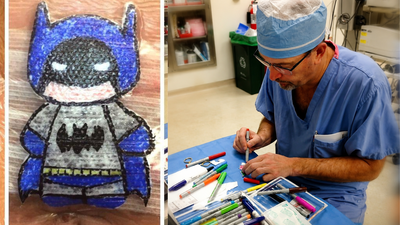
Waking up after surgery can be an overwhelming experience for a child, with unfamiliar surroundings, medical equipment and a bandage covering a fresh wound. At Akron Children’s Hospital in Ohio, paediatric surgeon Dr Robert Parry has found a simple way to make that moment a little brighter. After operating on children, Parry often reaches for coloured markers and turns their surgical dressings into personalised pieces of artwork. He has drawn everything from Snoopy and SpongeBob to superheroes, animals, cars and sports designs based on what his young patients love. Parry estimated in 2020 that he had personalised roughly 10,000 dressings during his career. The drawings take only a few minutes, but for many families they have become memorable reminders of kindness during an otherwise difficult medical experience.
How Dr. Robert Parry started drawing cartoons on kids’ bandages
The tradition began during Parry’s surgical training at the National Naval Medical Center in Bethesda, Maryland. He watched pediatric surgeon Dr. Perry Stafford cut shark silhouettes from Telfa dressings for children and saw how warmly patients and their families received the idea. Parry decided to try something similar and initially made shark shapes for boys and hearts for girls. Over the years, the practice evolved into personalized artwork. During consultations before surgery, he would ask children what kind of drawing they wanted on their dressing. Once the operation was over, he would create the requested design. By 2017, Akron Children’s reported that Parry had been delighting patients and staff with his artistic surgical dressings for about 20 years. He later continued the tradition at Akron Children’s after joining the hospital in 2011.
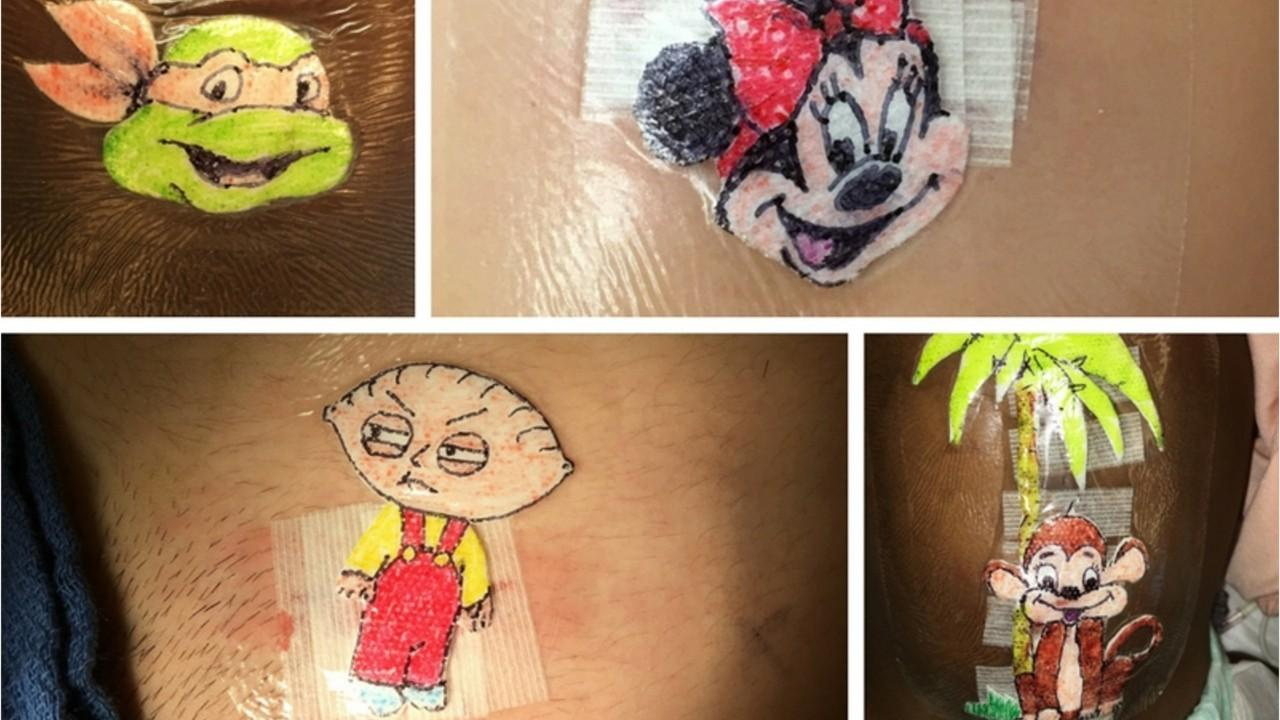
From Snoopy and SpongeBob to a hand-drawn Lamborghini
Parry’s designs are driven by the interests of the children he treats. His requests have included Mickey Mouse in surgical scrubs, Snoopy, Tom and Jerry, SpongeBob, football helmets for college and professional teams and Thanksgiving turkeys. He has also taken on more unusual requests when children wanted something specific. One memorable example involved 8-year-old Nicholas Sender, who shared a love of exotic cars with his father. When Parry asked Nicholas what he wanted on his surgical dressing, the boy requested a Lamborghini. Parry drew one for him, and Nicholas’s mother said the finished design looked remarkably similar to a Lamborghini Hot Wheels car Nicholas already owned. When Nicholas woke from surgery, the first thing he searched for was the dressing so he could see the Lamborghini. His mother said the drawing made him feel special and helped distract his attention from the wound and what was happening around him.
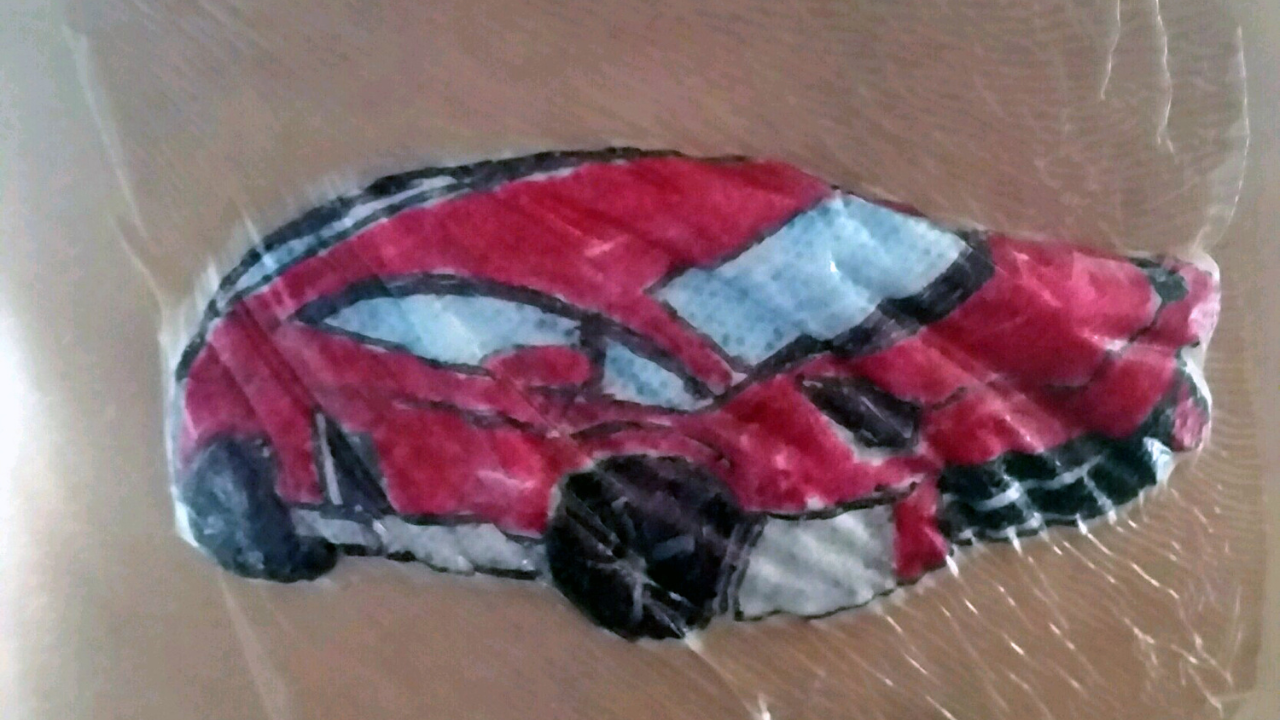
A few minutes of drawing after surgery
Parry’s artistic ritual is simple but highly personal. After an operation, he reaches for the boxes of colored pens and pencils that have become a familiar part of his work. He then creates a drawing on the child’s fresh surgical dressing based on the request discussed before surgery. His operating-room staff have reportedly enjoyed bringing him his pen set, which by 2017 contained about 30 markers. Parry has described himself as an accomplished artist and said he particularly enjoys unusual requests because they give him a chance to try something new. The hospital has emphasized that the drawings are a way for him to give his young patients a piece of himself and let them know they are not simply somebody he operated on.
When a bandage becomes a keepsake
The drawings do not always end up in the trash once the wound has healed. Some families have become attached to the artwork because it represents a memorable part of their child’s recovery. Akron Children’s once shared the story of an infant who received a Brownie the Elf dressing at his parents’ request. The child’s father liked the design so much that he did not want it removed when they returned for a two-week appointment. He enjoyed showing it to other people and asked Parry to make a new one. Other reports have also described families saving the artwork or placing images of the drawings in scrapbooks. What begins as a temporary medical dressing can therefore become a small keepsake that reminds parents of their child’s resilience and of the extra personal attention their surgeon gave them.
Turning surgery into a more positive memory
Parry has said that working with children is rewarding because of their resilience and optimism. Akron Children’s has highlighted his drawings as a way of giving patients a piece of himself and showing them that they are more than someone who simply underwent an operation. The hospital has said Parry estimates he has created dressing drawings for more than 10,000 patients, making that figure an estimate rather than an independently audited count. His work has also been featured by the hospital as part of its effort to help children continue to feel like children during medical care. There is no need to describe the drawings as a clinically proven treatment for postoperative anxiety. Their documented value is more human and immediate. They give children something familiar and enjoyable to see after surgery, while giving parents a moment of relief during an otherwise stressful experience. For Dr. Robert Parry, a few minutes with a handful of colored pens can turn an ordinary surgical dressing into something a child may remember long after the stitches are gone.