








Led by a growing domestic demand and a favourable demographic dividend, the Indian economy and its growth story have been called fundamentally strong by economists. But short-term global economic shocks, like the ongoing Middle East conflict, have the potential to temporarily slow the growth story – a fact that cannot be ignored if India hopes to be among the top three world economies in the coming years.In its latest Economy Watch report, EY has pointed out the need for India to ‘recast its growth strategy’ to keep the long-term story intact. “The Indian economy may experience pressures due to the ongoing West Asian crisis because of certain inherent vulnerabilities. The impact of sharply increased crude oil prices and the rate of depreciation of the Indian rupee is likely to have an effect on growth and inflation, as also fiscal and current account imbalances. This may, however, be a short-term shock, and India’s long-term growth prospects can remain intact, provided suitable strategic changes are undertaken,” says EY. But first let’s understand what India’s projected growth story is:
India’s long-term growth story: Overtaking US, China
To explain the growth potential of India, EY has cited a recent report by OECD that projects the GDP for around 139 economies till 2100. The OECD report looks at multiple scenarios, a majority of which suggest that by 2063 India will become the world’s largest economy in terms of PPP. At present, India is the third largest economy in PPP terms. OECD projects that India is likely to overtake the US by 2045 and China by 2063.
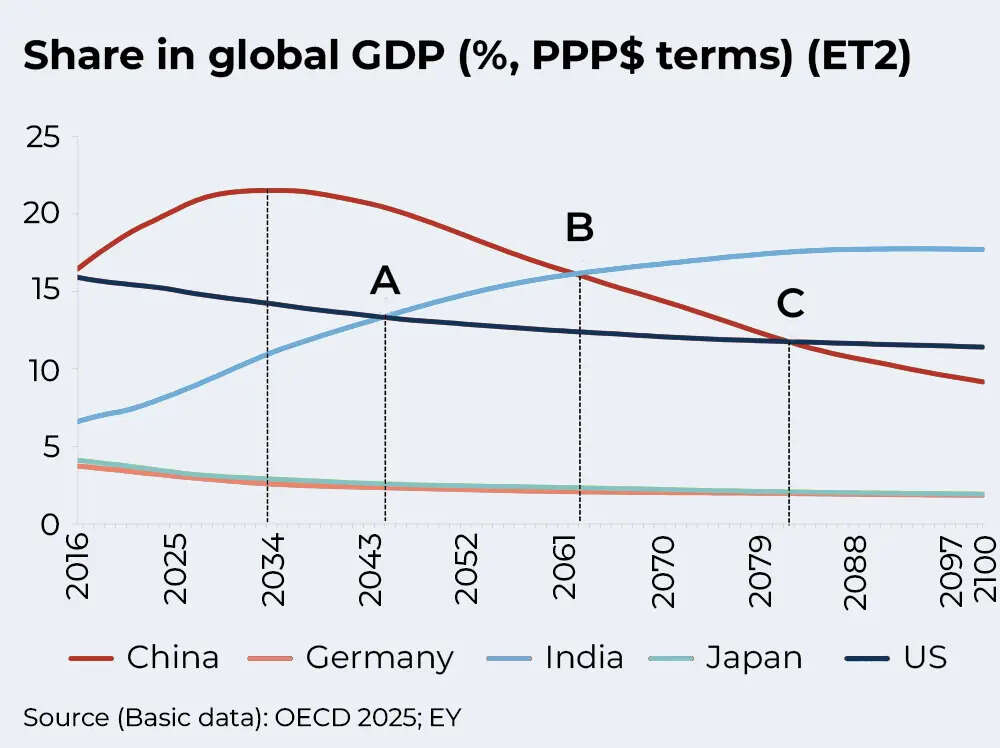
China’s share in global GDP is projected to decline significantly: from 21.5% in 2034 to below 10% by 2094. India’s share of the world economy will continue to rise until stabilising at about 17.7% from 2086 onwards. In 2100, the Indian economy is projected to be 55% larger than the US and 93.2% larger than China in PPP terms. However, despite rapid GDP growth, India’s per capita income is likely to rise more slowly because of continued population growth.India is projected to cross the global average per capita GDP level only in 2068.
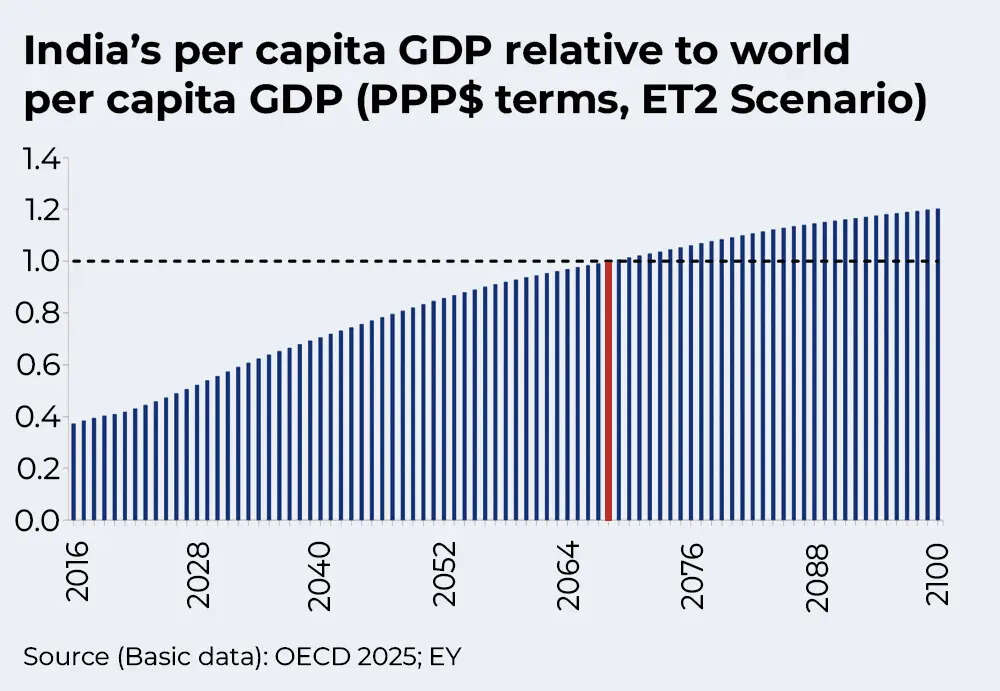
By the end of the century, India’s per capita GDP is expected to be nearly 20% higher than the global average, reflecting sustained long-term economic expansion.
How to keep India’s long-term growth story intact
But, to keep its long-term growth story intact, India will have to re-strategize and focus on some key factors that have come to light amid the Middle East conflict, suggests the EY report.While the impact on both GDP growth and inflation is likely to be limited to the ongoing financial year, EY stresses on the need to secure India’s long-term growth story.“The impact of the ongoing West Asia crisis on India’s growth is likely to be temporary, affecting only FY27 growth and India may be able to resume its long-term potential growth path soon afterwards,” says EY in its report.As EY says, in view of the structural changes in the world economic and trade order alongside the ongoing crisis, India may recast its growth strategy to cope with unanticipated economic shocks and cover India’s strategic vulnerabilities. This would necessitate: 1) Building up strategic reserves for crude oil, LPG, fertilizers, processed and unprocessed rare earth materials, and basic medicines and critical medical equipment, 2) Building dual-use infrastructure to minimize impacts of unanticipated nuclear and biological threats and 3) Re-strategize achieving sustainable levels of current account and fiscal imbalances.While India has managed to retain its fiscal deficit as per target in the last financial year, for FY27, both fiscal and current account deficit targets may be strained.“From a macro perspective, two imbalances that are critical pertain to the country’s current account and its consolidated fiscal account. Both are likely to come under pressure in FY27. On the fiscal side, there is a likelihood of a substantial increase in government subsidies for food, fertilizer and petroleum products,” says EY.The report notes that in the context of global competition for strategic and economic influence, policy choices by advanced economies may not always fully align with India’s priorities. This list may include the US and China. “At the same time, in many countries, populations are aging fast, and in spite of AI, some human resource-centric sectors may require human resources in countries with aged populations. These would include Russia and Japan, and some of the developed Western countries,” the report says.It advocates an approach where the education and training strategy should encourage students to choose Russia and Japan as destinations for education and training. “They (Indian students) can also learn advanced technology and get employed in these countries. AI and related fields, as well as medicine and nursing services may have an expanding demand in these countries,” it says.
Energy security topmost priority
However, the biggest takeaway from the report is that India’s response to the ongoing crisis should be focused on its energy security, since that is seen as the biggest channel of impact from a global vulnerability perspective, and one that feeds quickly into various branches of economic growth.For reducing India’s vulnerability to external crude price shocks, some of the steps that EY recommends embarking upon include: (1) Diversification of sources of crude imports (2) Accelerated domestic exploration and extraction of crude oil (3) Increasing the volume of strategic crude reserves (4) Faster adoption of non-oil energy sources and (5) Diversification and acceleration of alternative trade routes.In spite of the current impact of the ongoing West-Asian crisis, which might affect FY27 growth, EY expects India’s long-term growth story to remain intact.“However, certain policy measures are required to further reduce India’s dependence on imported crude oil and manage a faster transition to green growth. India may do well to accelerate its domestic exploration and extraction of crude oil. Further, an accelerated shift towards green and nuclear energy, which includes Thorium based production, focusing on developing indigenous technologies, may be needed along with a sharper shift towards electric vehicles,” says EY.
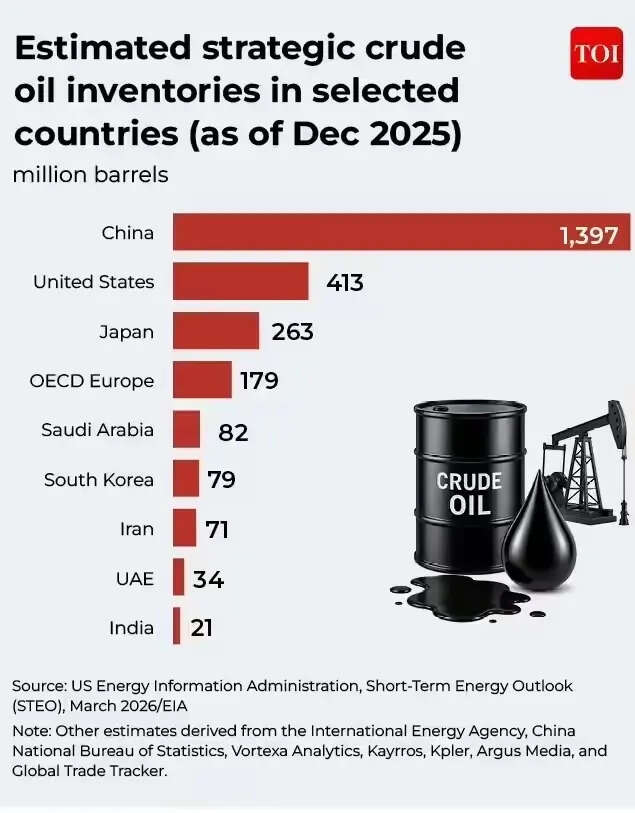
“Recent diversification of sources of petroleum has already helped India reduce its dependence on the Strait of Hormuz. India may need to work on diversification and acceleration of alternative trade routes, including the IMEC and the Indo-Pacific Corridor, covering the Malacca Strait,” it adds.With the Middle East crisis, India’s crude oil, LPG, and LNG supply has come under strain. Building adequate strategic reserves would help keep the economy stable in a situation of a supply shock.The report talks of strategic reserves not only in crude oil but other important areas such as LPG, fertilizers, processed and unprocessed rare earth materials, and basic medicines and critical medical equipment.In each case, there is a need to work out optimum reserves and a path towards achieving the desired level of reserves, the report says. It states that India’s strategic oil reserves fall much shorter compared to those of other major economies such as China and Japan. However, it acknowledges that India has managed to diversify its crude oil sources to 40 countries, hence reducing dependence on any one or few countries.
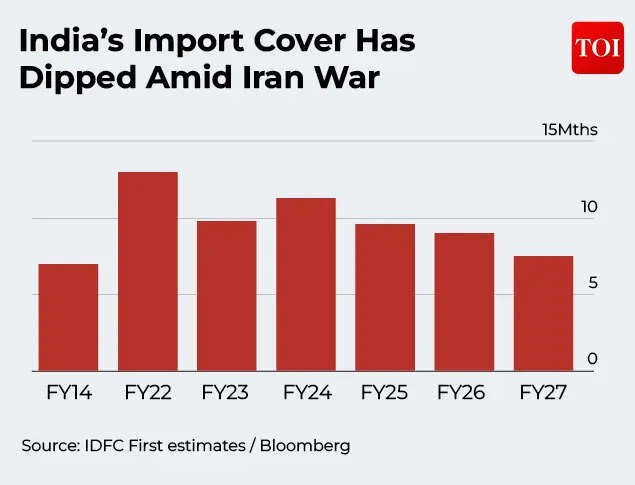
Similarly, the report recommends the need to have a sizable stock of foreign exchange reserves with a well-considered optimal composition including gold and other currencies. “India’s foreign exchange reserves had recently fallen by about $31.5 billion as on 08 May 2026 to $697 billion after having reached the peak of $728.5 billion as on 27 February 2026. In contrast, China’s foreign exchange reserves are about 5.5 times higher than India’s on an average,” says EY.India remains the world’s fastest growing economy, and is likely to retain that tag even this financial year despite the setback from the US-Iran conflict. However, as it hopes to become the world’s third largest economy in the coming years, and eventually a developed country by 2047, recaliberation of economic strategy with emphasis on reducing supply chain vulnerabilities, and securing energy needs of its growing population should form the cornerstone of economic policy making.