




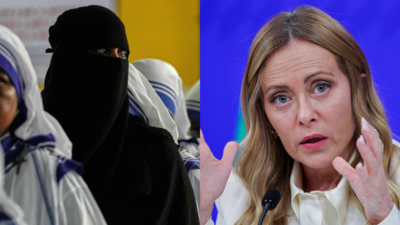
Italy has approved a controversial education reform introducing a ban on face coverings in schools and a 30 per cent cap on students of foreign origin in first-year classes, drawing accusations of discrimination from opposition parties.The reform, approved by the Chamber of Deputies with 142 votes in favour, 112 against and four abstentions, also introduces Italian language courses for foreign parents whose children face difficulties integrating into the country’s education system.The legislation, known as the Decreto Scuola, had earlier been approved by the Senate on November 20. It is part of Decree-law 170 of September 30, 2026, which introduces measures to ensure the regular start of the 2026-27 academic year, support initiatives under the National Recovery and Resilience Plan (PNRR) and promote the integration of foreign students.The new rules will prevent Muslim female students from wearing burqas and niqabs in classrooms. However, the 30 per cent cap on students of foreign origin will not apply to those who have already acquired an adequate knowledge of Italian.The final vote in the lower house was marked by protests from opposition lawmakers, who displayed a sign reading “At school nobody is a foreigner” in the chamber.What the new education reform proposesThe 30 per cent limit on non-Italian students is not entirely new. A similar restriction was introduced through a 2010 ministerial circular issued by then-Education Minister Mariastella Gelmini. However, it has often gone unenforced because of local demographic conditions and a lack of flexibility, particularly in urban outskirts.The latest legislation also provides for Italian language courses for foreign parents, particularly those whose children face serious difficulties integrating into the national school system.Earlier this year, Prime Minister Giorgia Meloni announced that her government was preparing legislation to ban burqas and niqabs in schools, restrict the number of foreign students in classrooms and require parents of children facing integration difficulties to learn Italian.At a rally organised by Gioventù Nazionale, the youth wing of her Brothers of Italy party, Meloni defended the proposed restrictions, arguing that Italian students should not become minorities in their own classrooms.“It is unacceptable that in an Italian classroom the children who end up feeling pushed into a corner are Italian children because they have become the minority. That cannot be allowed,” she said.“Calling all this integration is yet another lie, a convenient lie for those who live off ideology, for those who preach to us from their living rooms and then send their own children to schools where this problem does not exist.”Growing restrictions on face coverings across EuropeItaly’s move comes amid wider restrictions on face coverings across several European countries. France and Belgium have already introduced nationwide bans on concealing the face in public places, while Austria has imposed restrictions in educational institutions.The Italian legislation specifically targets burqas and niqabs. A burqa traditionally covers the entire body, including the eyes with a mesh screen, while a niqab covers the face, leaving only the eyes visible. A hijab, in contrast, covers the hair and neck but leaves the face uncovered.France introduced a nationwide ban on concealing the face in public places in April 2011, a measure subsequently upheld by the European Court of Human Rights. Belgium followed with a similar ban in July 2011, prescribing fines and prison sentences for violations.Bulgaria has prohibited full-face veils in state, administrative and educational institutions since September 2016. Austria introduced an anti-mask law in October 2017, requiring faces to remain visible in public spaces. From September 2026, girls up to the age of 14 will also be prohibited from wearing veils covering the head according to Islamic traditions in schools.Denmark introduced a nationwide ban in August 2018, with financial penalties increasing for repeat violations. The Netherlands followed in August 2019 with a partial ban covering schools, hospitals, government offices and public transport.Switzerland introduced a federal ban on face coverings in public spaces following a national referendum, with the implementing legislation taking effect in 2023. Portugal completed its legislative process in August 2026 with a law prohibiting face coverings in public spaces and prescribing financial penalties.Germany, meanwhile, has no nationwide ban but has restrictions on face coverings for public employees, judges, members of the armed forces and motorists. Several German states also restrict full-face veils in schools and universities for students and teachers.Migration debate intensifies ahead of electionsThe reform comes as migration remains a divisive political issue in Italy, with the country scheduled to hold elections next year.Competition to the right of Meloni’s party has intensified following the entry of retired general Roberto Vannacci into the political arena. Vannacci has advocated even tougher measures on migration.Meloni’s government has increasingly placed integration and restrictions on migration at the centre of its political agenda, with the latest education reform bringing these issues into the country’s school system.