









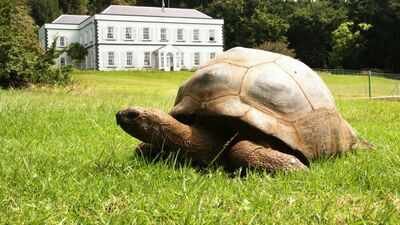

We have all heard the remedies that can ensure our long life. There is enough literature on the internet concerning our longeivity, from regular movement and nutritious food to avoiding tobacco and alcohol. However, now we are left wondering the secret behind Jonathan, the tortoise who is 194 years old. Is there a fitness routine we can follow or a magic potion that is preventing him from aging? Well, researchers have found an answer in his genes and you will be interested to know as it might hold some secrets to human aging as well.
The story extending almost two centuries
Jonathan is an Aldabra giant tortoise (Aldabrachelys gigantea) that hatched in 1832. Queen Victoria hadn’t even taken the throne, the US wasn’t a superpower, the world did not have atomic bombs and the climate wasn’t the number one emergency in the world. Now, almost 200 years later, Jonathan is living his best and usual life, chewing leafy grass and not caring about the world. At an estimated age of 194 years, he is the oldest living giant tortoise. He is also the oldest known living land animal on Earth.Jonathan lives in St Helena, a British Overseas Territory in the middle of the South Atlantic, on the grounds of Plantation House, the governor’s official residence. He arrived from the Seychelles 144 years ago as a gift for the governor, and he was already fully grown when he stepped off the boat. Scientists have now taken a very close look at his DNA to find out how he’s done it.
Counting the clues
A research team led by Kallel, a US longevity non-profit, in their study, published in Science Advances, pinpointed 287 distinctive genetic variants that seem to dial down the usual effects of aging.According to the University of Cambridge’s report on the study, these genetic variants are associated with DNA repair and metabolism including keeping inflammation in check and regulating insulin. The team of researchers gained interesting insights from studying Jonathan’s epigenome. Epigenomes are a set of chemical markers that decide which, when, where and how a gene has to be turned on or off. As reported by Science Daily, these regulatory mechanisms generally change as animals grow older which involves disruption of important cellular processes and other age-related deterioration.Jonathan’s markers barely seem to have drifted. When the researchers compared him with younger giant tortoises of the same species, the switches governing DNA repair and metabolism looked remarkably similar. In other words, a nearly 200-year-old tortoise is running his cellular controls much like his young relatives.“We found that the gene regulators involved in energy production and DNA repair have remained incredibly stable in Jonathan over almost two centuries,” said Dr Justin Gerlach of Peterhouse, University of Cambridge, as ScienceDaily reported.This was also the first time anyone had examined the epigenome of a giant tortoise, so Jonathan is breaking new scientific ground as well as age records.
Before we all start eating lettuce
It’s tempting to read this and conclude that the secret of eternal youth has been found. Hold that thought. Though the study provides insight into the biology of animals capable of surviving for centuries, it can tell us important details about how extreme longevity can manifest. Moreover, applying these genetic variants to humans will require extensive research.The study of a single tortoise can also be a limiting factor in extrapolating the results. However, Stephen Clark, Kallel’s founder and the study’s senior author, is more ambitious. He describes Jonathan’s genome to Science Daily as a blueprint for cellular resilience and says the goal is to turn evolutionary insights into practical, affordable treatments for ordinary people.