









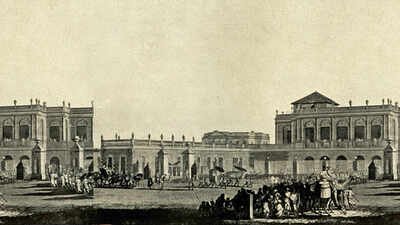
A newspaper that scandalised colonial Calcutta, ridiculed its most powerful officials, advertised everything from fashionable goods to enslaved people, and continued publication even after its editor was imprisoned has returned, 246 years after its birth.American historian Andrew Otis — who holds a PhD in journalism — has recently launched hickysgazette.com, a searchable digital archive of Hicky’s Bengal Gazette, India’s first newspaper.
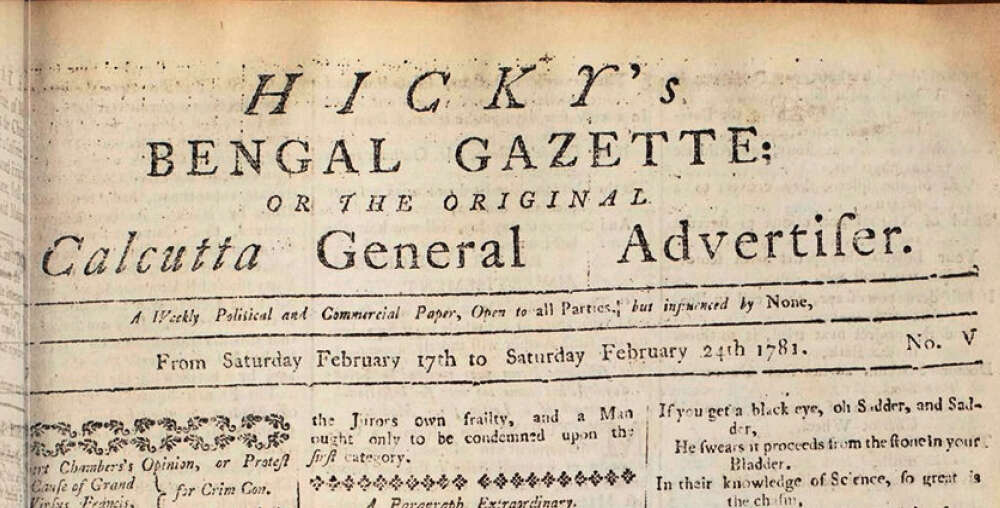
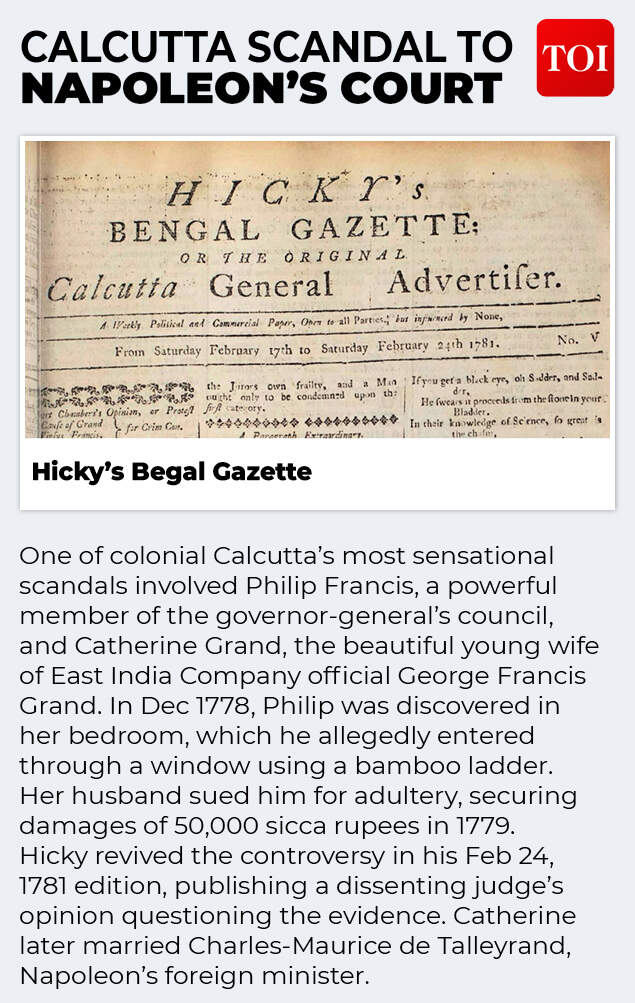
Hicky’s Bengal Gazette
The gazette was a weekly, printed every Saturday, with the first issue on Jan 29, 1780, and the last on March 30, 1782. What Otis has done through a long labour of love is to bring together on one platform all known surviving issues scattered across seven incomplete collections in six archives spread over five countries: India, UK, Germany, Australia and the US.
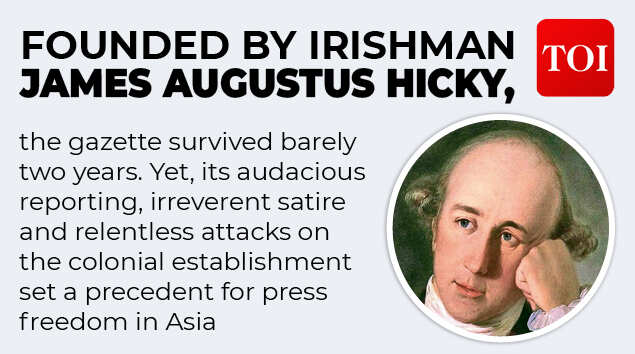
Otis’s initiative is more than an exercise in preserving journalistic heritage. It opens an extraordinary window into the everyday life, scandals, commerce, political intrigues and social contradictions of 18th-century Calcutta, when the city was emerging as the nerve centre of British power in India.Founded by Irishman James Augustus Hicky the weekly survived barely two years. Yet, its audacious reporting, irreverent satire and relentless attacks on the colonial establishment set a precedent for press freedom in Asia.
Hicky printed 121 issues and a prospectus, comprising 464 pages. No institution possesses a complete collection. The website brings the surviving pages together chronologically, accompanied by searchable transcriptions.Hunt across continentsOtis’s journey to reconstruct India’s first newspaper was itself an adventure.During his Fulbright fellowship in Kolkata, he tracked down copies at the National Library of India but was denied permission to photograph or digitally scan those. Undeterred, he purchased paper photocopies, carried them home and scanned them himself.
An even more exciting discovery awaited him at Calcutta High Court.Buried in its record room for over 230 years was a special edition dated June 25, 1781. Hicky printed this edition to argue for the freedom of speech after governor-general Warren Hastings’s Supreme Council forbade the gazette from being mailed through the post office, after Hicky was highly critical of his administration.Otis, during his research, found that the high court, too, prohibited cameras. He had no choice but to copy the entire page by hand.Another stroke of luck came during a cleanup of Heidelberg University’s archives in Germany, when copies of the gazette were discovered in the collection associated with George Livius.In 2015, Otis proposed bringing the scattered editions together at the British Library in London. But his proposal, made as an unfunded researcher, received no encouragement.Eleven years later, the digital archive has finally realised that ambition.Assassination attempt on editor?The newspaper’s contents could easily compete with today’s more sensational headlines. In its April 14, 1781 issue, Hicky reported an apparent assassination attempt at his residence, allegedly involving two Europeans.According to his account, his servants foiled the attack.One suspected intruder was later identified as a man occasionally employed around Calcutta’s Play House.Although Hicky’s account cannot be independently accepted in every detail, it does offer a gripping glimpse of the hostility surrounding the rather outspoken editor.Slaves, bungalows & bazaarsThe advertisements reveal an equally fascinating, sometimes disturbing, portrait of colonial Calcutta.An advertisement dated Feb 19, 1780, offered a property planted with fruit trees, along with two enslaved Africans described as “Coffee Slaves” — who are described as “stout men” — from the estate of the late Andrew Stein. It is a stark reminder that slavery formed part of the city’s colonial commercial economy.
Elsewhere, a Nov 1780 advertisement offered a garden and bungalow occupying 32 cottahs near China Bazaar. Another announced the auction of a wet dock, warehouses, vessels and stores near the Old Fort.The snippets reveal a thriving property market and a city populated by merchants, auctioneers, shipping agents and traders.One advertisement, published on June 30, 1781, announced the relocation of a circulating library from the Old Fort to a more comfortable building behind the Riding School. Its proprietor, John Andrews, advertised the new location near the residences of George Livius and a jeweller named Schultz.The notice reveals that Calcutta had a commercial circulating library long before many of its celebrated educational and cultural institutions emerged.Mocking the mightyHicky reserved his sharpest attacks for the powerful. Governor-general Hastings and Chief Justice Elijah Impey became frequent targets. To ridicule officials while making identification difficult, he deployed mocking nicknames.
He reportedly called Impey “Poolbundy”, alluding to allegations concerning contracts for repairing Bengal’s embankments. Justice Robert Chambers became “Sir Viner Pliant”, referring to his academic background and allegations about his relationship with Hastings.Hicky also accused Swedish missionary Johann Zacharias Kiernander of misusing funds meant for educating orphans. His satire extended to mock classified advertisements. One announced that sincerity and honesty had gone missing. Another sought someone determined neither to offer nor accept bribes.The humour may be 18th-century, but the targets sound remarkably contemporary.Postal ban to prisonHicky’s troubles intensified when the colonial administration moved to restrict his newspaper’s circulation. A notice published on Nov 18, 1780, which recorded the official order prohibiting distribution through the postal system, is an early example of how governments could undermine independent journalism by controlling its distribution.Following libel proceedings, Hicky was imprisoned in June 1781. Remarkably, he continued publishing from prison before several months. The final blow came in March 1782, when authorities seized his printing press and types, silencing India’s first newspaper.Otis, whose book ‘Hicky’s Bengal Gazette: The Untold Story of India’s First Newspaper’ (published 2018) reconstructed the editor’s remarkable career, has now made the surviving newspaper accessible to a global readership.The archive is completely searchable, and offers researchers opportunities to trace recurring names, advertisements, controversies and forgotten episodes of Calcutta’s urban history.
Share your thoughts in the comments
Be respectful · TOI community guidelines
Hicky was not always restrained or fair. His journalism mixed serious allegations of corruption with gossip, personal attacks and provocative satire. But his greatest legacy was his determination to question those wielding power.Nearly two-and-a-half centuries later, the digital resurrection of Hicky’s Bengal Gazette allows Kolkata to rediscover not merely the birthplace of Indian journalism, but a colourful, commercially vibrant and deeply unequal colonial city whose first newspaper dared to challenge its rulers.The printing press was silenced in 1782. Its pages have found a new voice in 2026.